


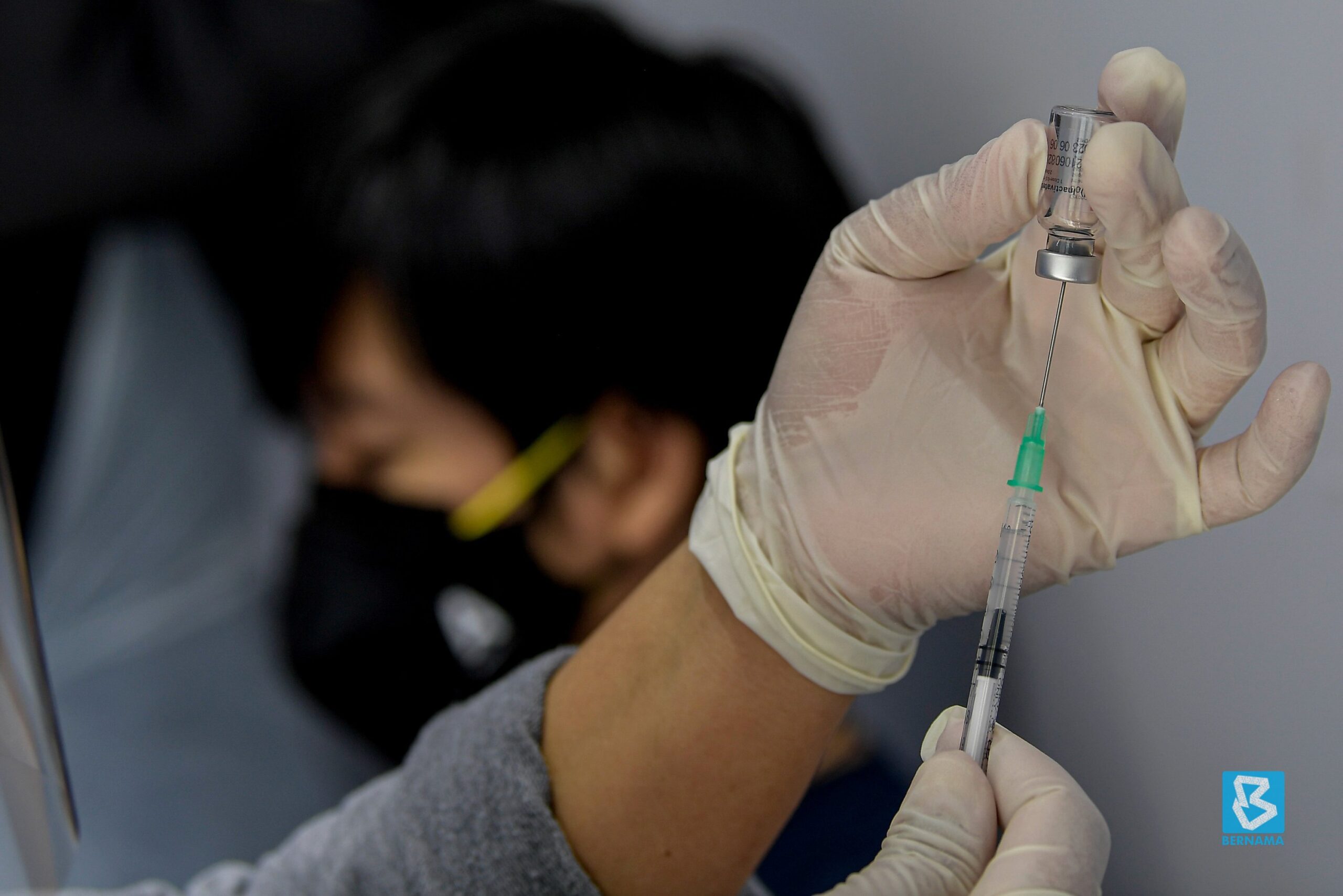
A medical worker prepares a dose of Covid-19 vaccine. — Bernama photo
KUCHING (Aug 11): Bandar Kuching MP Dr Kelvin Yii believes it is time the federal government and Special Committee on Covid-19 Vaccine Supply (JKJAV) consider reversing their decision to withhold the immunisation of children between 12 and 17 in the country.
He reasoned that the benefit of vaccination outweighs the risk of getting infected, especially now with the emergence of new variants such as Delta, Lambda and Delta Plus that are more transmissible.
He said vaccinating children 12 to 17 years old was necessary because schools would reopen soon, and the prime minister’s recent announcement on relaxing travel restriction for parents wanting to meet with their children of below 18 years old.
“While parents may be vaccinated, they are going to meet their children who have not been vaccinated, risking them not only to be infected but also for their children to be ‘reservoirs’ to spread the virus to others, and possibly even a reservoir to develop new variants.
“Data has shown that children, particularly adolescents, can play a significant part in Covid-19 transmission, especially to high-risk groups including grandparents and other family members with comorbidities.
“With the new variants, the disease pattern has changed, and the younger people are getting infected with Covid-19 even in Sarawak,” he said when asked to comment on the prime minister’s announcement that Covid-19 restrictions would be eased starting yesterday (Aug 10) for those who have been fully vaccinated.
Yii said many children did develop more severe symptoms, and in some extreme cases even death.
He said 0.52 per cent, or 15 of the 2,867 Covid-19 deaths reported in Malaysia as of June 1, occurred among children below 18.
“While I do understand the concern about side effects, especially myocarditis (heart inflammation) reported, especially in the USA, the incidents are very small – 40 cases per one million doses of the Pfizer vaccine administered to male population aged 12 to 29.
“Young people who develop myocarditis from the mRNA vaccine mostly experience a mild illness, and virtually all of them recover spontaneously or with minimal treatment. No deaths have thus far been reported,” he said.
Yii, however, said the risk of boys 12 to 17 years old developing myocarditis and pericarditis from SARS-CoV-2 is estimated to occur at 876 per million. This is 13 times more than the risk of them developing it from the mRNA vaccines (67 per million).
He said for girls 12 to 17 years old, the risk of developing myocarditis and pericarditis from primary Covid-19 infection is 213 per million. This is 24-fold the risk of getting it from the mRNA vaccines (nine per million).
“Besides the mRNA vaccine, other vaccines including Sinopharm and Sinovac have also been tested in young people 12 years and older. Several countries, including the United States, Israel and China, are now offering vaccines to this age group.
“The vaccines seem to be safe in adolescents. Some companies have moved on to carrying out clinical trials in children as young as six months old. In the United States, vaccines for those under 12 may be available later this year,” he said.