


Miri-based NGO calls upon government to look into having better provision of facilities for individuals with disabilities
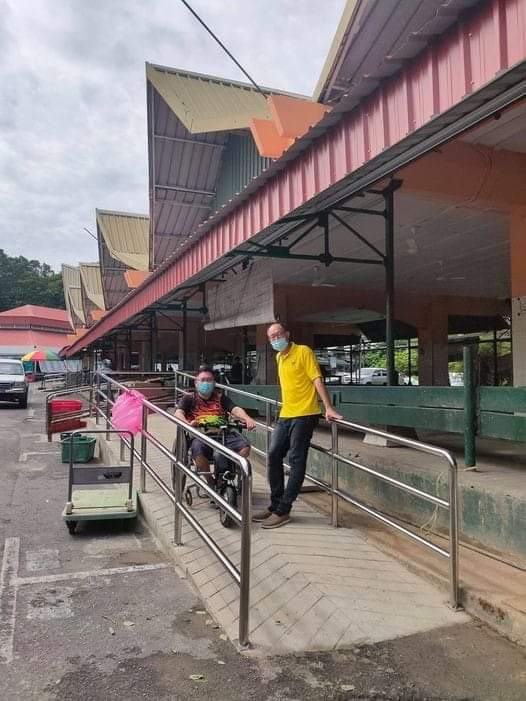
Boon and Councillor Leong seen at the newly-built wheelchair ramp at Tamu Muhibbah in Miri.
BEING able to live independently and confidently, as well as going places without fearing over any incident when one is alone, are basically what individuals with disabilities (PwDs) often hope for.
Regardless the type of disability that a person has, being able to live in a safe, barrier-free environment would be regarded by them as ‘a gift of life’.
For the rest of us, we must first understand the definition of PwDs before we can even comprehend what a barrier-free environment truly is.
According to the Persons with Disabilities Act 2008, the PwDs include those with long-term physical, mental, intellectual or sensory impairments, and whose interactions with various barriers may hinder their full and effective participation in society.
There are seven categories of PwDs considered by the Department of Welfare (JKM) in identifying those qualified for registration: those with physical disability, those with hearing disability, those with visual disability, those with speech disability, those with learning disability, those with mental disability, and those with multiple disabilities (more than one disability).
Physical disability is permanent inability of the parts of the body, which can affect a person in fully carrying out basic activities such as self-care, basic movements and changing the positions of the body.
Limb defects – congenital or acquired, including loss of thumb, spinal cord injury, stroke, traumatic brain injury, ‘achondroplasia’ (dwarfism) and cerebral palsy are sub-categories under physical disability.
Visual disability can be classified into two: low vision (visual field less than 20 degrees from fixation) and blindness (visual field of less than 10 degrees from fixation).
Mental disability is a condition where severe mental illness causes the inability to function in a person and hinder one from carrying out daily activities. The types of mental-illness categories considered as ‘serious and chronic’ are organic mental disorder, schizophrenia, paranoia, mood disorder (depression, bipolar), psychotic disorder and schizoaffective disorder.
The way it is called
The term ‘disabilities’, in the PwD term, however, should have been better explained not only to avoid stigmatisation, but to also allow the PwDs have better confidence in themselves.
The PwD term in Bahasa Malaysia, OKU, is originally an abbreviation for ‘Orang Kurang Upaya’, which means ‘individuals with limited abilities’ – nowadays, due to higher awareness, the initialism now stands for ‘Orang Kelainan Upaya (individuals with different disabilities).
Boon Foo Ping
For Miri Ability Services Association (Masa) president Boon Foo Ping, he believes that Miri, with its city status, should have in place more facilities for PwDs of all ages and backgrounds.
He says as a non-governmental organisation (NGO) advocating for this group, Masa constantly calls upon the government to pay more attention to better provision of barrier-free facilities.
Established in 2018, the association now has over 200 registered members.
Through its motto ‘Towards A Barrier-free Society’, it aims to assist PwDs integrate into society where they have the same rights as the able-bodied people to enjoy good-quality life and also to contribute to the community.
Boon, who has been wheelchair-bound for more than two decades following an accident that left him with spinal cord injury, founded Masa with an intention of highlighting the plights faced by the PwDs and getting the right kind of attention from the relevant authorities.
Based on his own personal experience as wheelchair-bound person, Boon feels that more Malaysians need more awareness of the needs of his fellow PwDs.
“I’ve met kind people who would be happy to help, but with good facilities for our community, we can save precious time and are able to be independent doing simple things,” he told thesundaypost.
Boon felt that in Miri, the facilities for PwDs was just not enough.
“Parking spaces for PwDs are available only at certain parts of the city and even then, they are sometimes occupied by the vehicles of non-PwDs.
“Tactile paving is not commonly available; in places where it is there, the design is not ideal in meeting the movement needs for those with visual-impairment.”
Nevertheless, Boon acknowledged that in recent years, the Miri City Council (MCC) had been placing more emphasis on facilities meant for the handicapped individuals.
In this regard, he also stressed the importance for such facilities to also have ‘universal design’ – one that would provide comfort and convenience to everyone, and not just the specific users.
In definition, ‘universal design’ is one that accommodates all and does not discriminate certain quarters based on different abilities and other aspects.
The local government, Boon suggested, should work closely with the PwD community in terms of upgrading any facility.
“It would be even better to incorporate ‘universal design’ as part of the by-laws.
“Any PwD-friendly facility should be build according to the Malaysian Standard (MS) Code of Practice on Access for Disabled Persons – the facilities must cater for wheelchair users, crutch users, blind people (including those with low vision) and deaf people.
“Masa is more than happy to share advice, as far as this is concerned,” he said.
Tamu Muhibbah has several facilities for the PwDs.
Recently, MCC undertook upgrading works on the facilities at several wet markets in areas under its jurisdiction and for this endeavour, it had engaged Masa for advice and recommendations concerning the suitability of the facilities.
“We are hoping to see Sarawak progress towards becoming a barrier-free society, where public facilities facilitate the PwDs, such as every bus being equipped with movable platform to accommodate wheelchair-bound passengers, or audio-guide to accommodate the visually- impaired individuals.
“Such facilities would make PwDs feel inclusive; that they are a part of society,” said Boon.
Safer environment
In the Federal Constitution 1957, Article 8 (2) declares equal rights for all citizens including people with disabilities. However, the PwDs are still facing problems in that they are deprived of simple basic rights such as freedom of movement to access to facilities such as education, employment and social activities, due to the fact that schools, business premises, workplaces, public transport and the majority of public facilities are just beyond their reach.
A research article by SA Kadir, M Jamaludin and AA Rahim on ‘Building Managers, Views on Accessibility and UD Implementation in Public Buildings: Putrajaya’ published in 2013 by Journal of Asian Behavioural Studies, highlights that although there is a positive development in terms of public awareness, accurate understanding of the ‘universal design’ theory is still low in Malaysian society.
The sample size of the research was focused on Putrajaya – being the centre of government administration and also a tourist attraction means that the Federal Territory is often visited by people from various backgrounds.
Hence, the outcome of the interviews with the research candidates and their points of view over the structural buildings and the facilities, are relevant in reflecting the knowledge on the facilities meant for the handicapped group.
According to Councillor Aries Leong from the MCC, who is also a developer, there is a dire need for the government to really look into this matter, and truly ensure that the rights and welfare of PwDs are being attended to.
“My experience of living in other developed countries like Singapore and the UK many years ago, has shown a stark contrast between these countries and Malaysia.
“This is even more so for Sarawak, where the gap between Peninsular Malaysia and us is still wide. This signifies the need for our state government to assume a more proactive role towards making changes and help improve their (PwDs’) living quality,” said the councillor.
He, however, said among the reasons behind the lack of facilities for PwDs could be the cost.
Photo shows a couple of parking spaces for PwDs, and also the side ramp at Marina Times Square Commercial Centre.
“Basic PwD designs that we often see are the designated parking spaces, ramps for wheelchairs, special toilets, and tactile paving. Actually, there are many more facilities that are needed to make the lives of the PwDs more manageable and stress-free,” he pointed out.
“Public bus and taxi services with movable platforms for wheelchair passengers, as well as staircases, escalators and elevators with safety features for the visually-impaired and deaf-mute groups are among the much-needed facilities that are still lacking.”
Leong also suggested that the state government would strictly opt and implement the Green Building Index (GBI) as a standard prerequisite for all developments in Sarawak, in that GBI is also regarded as an element of ‘universal design’.
Developed by Malaysian Institute of Architects (IAM) and the Association of Consulting Engineers Malaysia, the GBI is Malaysia’s industry-recognised green-rating tool for buildings to promote sustainability in the built environment and raise awareness of these issues among relevant stakeholders such as developers, architects and contractors.
“The assessment of commercial and residential properties under GBI is based on six main criteria – energy efficiency, indoor environment, quality, sustainable site-planning and management, materials and resources, water efficiency and innovation.
“The PwD-friendly designs are categorised under GBI’s community planning and design, whereby points would be given based on the evaluation over the quantity of designs available for this group of users.
“Environment accessibility, under GBI, focuses on benefitting people with disabilities, which includes sidewalk curb cuts, designs on sidewalks and streets accessible to wheelchair users, and also to others such as children and parents with baby strollers.
“It is also worth to acknowledge that in efforts towards encouraging the popularity and adoption of green buildings, financial institutions in Malaysia beginning to offer either lower interest rates or higher loan amounts on green properties,” said Leong.
Identifying the need to improve the ‘universal design’ at public places such as markets, Leong said the MCC had been working with Masa regarding this aspect.
“Several ‘tamu’ (farmers and jungle produce markets) and public markets in Miri underwent renovation and refurbishing works previously and in this area, I had discussed ideas with Masa on ways to add suitable facilities.
“Adding wheelchair ramps at the entry points of these markets and removing bollards at some pedestrian lines in the city are among the efforts meant to make our city more PwD-friendly,” he said.
The near-complete MCC’s city hall near Marina Recreational Park, added Leong, would be one of the most significant buildings in Miri set with all the ‘universal design’ facilities meant for the convenience of the PwDs.
“We hope it could be a prime example for other developments in the city.”
Taking the lead in making changes
Masa is in the midst of raising funds to purchase a specialised vehicle – specifically, a van with hydraulic-powered wheelchair lift.
Photo indicates the basic mechanism involved in lifting a wheelchair-bound passenger onto this specialised van.
“Wheelchair users often need more than one person to assist them whenever they need to board onto a vehicle.
“We realise the lack of such service (van for PwDs) at an affordable price here; hence, this idea was born.
“With this specialised vehicle, wheelchair users need only to contact us, and we’d ferry them to their destinations. Not only can they get in and out of the vehicle without much hard work, it would require only one person or a guardian to accompany them,” said Boon.
The association is still raising funds to purchase a van with hydraulic-powered wheelchair lift, for transportation of wheelchair-bound passengers.
According to him, Masa had found a second-hand vehicle, but it was too expensive to maintain.
“There is a lot of old parts requiring replacements. So, buying a new one would be much more economical.
“Once Masa has acquired the right vehicle, it would kick off its transportation service for the PwDs, and also for the elderly folk.
“This is our first step in giving PwDs a chance to experience a barrier-free facility, without them having to burn a large hole in their pocket.”
It is reported that to date, Masa has raised RM20,000 – the association would still need an additional RM100,000 to be able to purchase a decent barrier-free vehicle.
Those wishing to help Masa could contact Boon via 014-687 1981.