


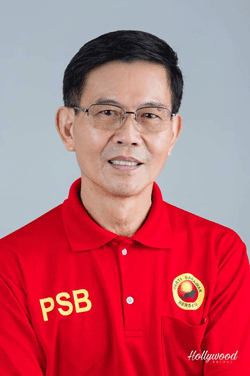
Liu Thian Leong
KUCHING (July 16): The state government should demonstrate innovation, competency, and good autonomous governance during this time of political turmoil at the federal level and Covid-19 pandemic, opined Parti Sarawak Bersatu (PSB) Batu Kitang chairman Liu Thian Leong.
He said this could make up for the federal government’s slow response and inadequacies in solving the state’s problems.
“Do not get me wrong. We are not taking advantage of the political and economic situations in the country but I think that circumstances in Malaysia have given us a rare opportunity to make inroads to recover many rights and autonomy provisions that have been eroded or sidelined,” he said in a statement yesterday.
He said Sarawakians would like to see a great blueprint charting the pathway to gradually resume control over the state’s resources such as oil and gas, taxes and stamp duties, and eventually regaining full autonomy for Sarawak.
Liu said such elements could also be incorporated in Sarawak’s Roadmap to Recovery Plan (RRP) to reflect the sentiments and aspirations of Sarawakians.
According to him, Sarawakians will face greater disaster in future should the state government not take action now.
He claimed federal political turmoil, the widespread hardship of the B40 and M40 groups, and the ‘white flag movement’ for food aid have tarnished the image of Malaysia internationally.
“Alongside with the world wide pandemic, Malaysia unfortunately also entered into one of the most turbulent and unstable phases in history,” he said.
Commenting on how the federal government is currently handling the Covid-19 crisis, Liu opined the government’s compromise on its self-imposed conditions for political reasons would lead to even greater disasters with lives and the economy in future.
He said when the State Disaster Management Committee (SDMC) announcing Sarawak would enter Phase 2 of the National Recovery Plan (NRP) on July 14, there was a dramatic rebound of Covid-19 infections to a high of 472 cases for the week on July 13 coupled with Delta variant cases being recorded in the state.
“It served as an anticlimax to the joy of many people. Worse still, on the national front, the infected cases reached a record high of 11,079 on the same day. This left the people sceptical about whether the government can really keep the Covid-19 infection under control to implement the NRP as planned,” said Liu.
He pointed out the prerequisite for the successful implementation of NRP in stages is the fulfilment of conditions, namely average daily Covid-19 cases, healthcare capacity, and population vaccination at satisfactory levels.
However, both state and federal governments are still struggling to bring down Covid-19 infections to the required level despite many rounds of Movement Control Order (MCO) and various standard operating procedures (SOPs), he said.
“It is worth pondering why Singapore, which had a similar Covid-19 spike and has enforced similar MCO and SOPs, is able to bring the Covid-19 infections down effectively. One of the most important reasons we can see is that Singapore has been able to administer extensive testing and tracing, followed by efficient isolation, and treatment.
“It is frustrating to see that our governments fail to strategise and prioritise on these crucial aspects of prevention, either at the workplace or at the general public at large,” he said.
According to him, the state government’s RRP is very much a duplicate of the NRP.
“Unless the spread of Covid-19 is contained, it will be doubtful as to what extent the RRP can be implemented,” he added.