


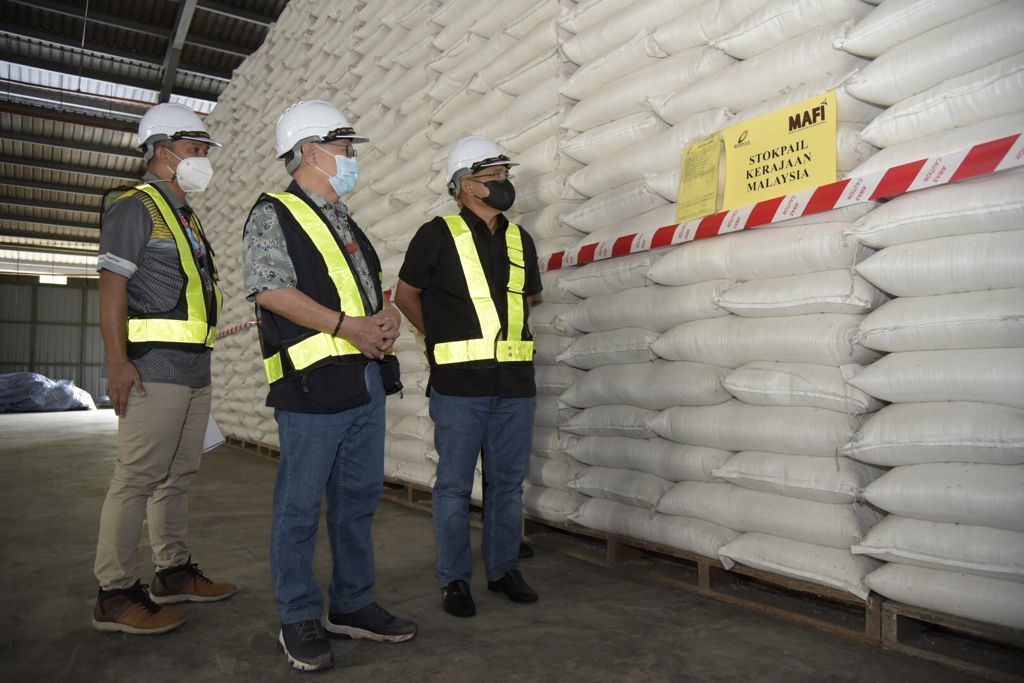
Dr Ronald (right) and Dr Jeffrey (middle) inspecting the rice stockpile during the inspection on Saturday.
KOTA KINABALU: The padi and rice industry is an important one as it produces the staple food of Malaysians, said Agriculture and Food Industry minister Datuk Seri Dr Ronald Kiandee.
According to him, the annual requirement of rice for Malaysians is 2.5 million metric tonnes while the country’s rice production is around 70 per cent of that requirement.
Therefore the country still imports 700,000 to 900,000 metric tonnes of rice annually to meet the domestic demand for premium and speciality rice, he said.
Speaking to the media after visiting the national rice stockpile warehouse in Telipok here on Saturday, Dr Ronald disclosed that the padi and local rice industry’s operation was not affected by the Covid-19 pandemic.
“The government placed agriculture activities, including padi planting activity as essential service to ensure that the country’s food supply is always sufficient and easily accesible by the rakyat at all times.
“The government in guaranteering the continuity of the country’s staple food supply as well as ensuring the sufficient rice stock, will ensure the smooth operation of the padi and rice industry as well as its chain of industries,” he stressed.
Dr Ronald was accompanied by Deputy Chief Minister cum Agriculture and Fisheries Minister Datuk Dr Jeffrey G. Kitingan and MAFI’s Padi and Rice Supply Regulator’s Director General Azman Mahmood.
The visit was in line with the terms of the concession agreement between the Malaysian government and Syarikat Padiberas Nasional Berhad (BERNAS) to ensure that the country’s rice stockpile is always sufficient and in good condition at all times.
There are 31 rice stockpile warehouses nationwide in Peninsular Malaysia, Sabah and Sarawak respectively.
The concession agreement signed in December 2020 has set 10 social obligations to BERNAS which will be monitored and evaluated annually by the government.
One of the main social obligations is to preserve, maintain and manage the country’s rice stockpile by complying with all safety guidelines and Standard Operating Procedures (SOPs) as prescribed by the government.
According to Dr Ronald, as agreed in the concession agreement, the country’s total rice stockpile will also be increased to 290,000 metric tonnes in stages by 2023.
The additional cost of the country’s rice stockpile of RM250 million will be fully borne by BERNAS.
By the end of this year, BERNAS will increase the country’s total rice stockpile holdings from 150,000 tonnes to 200,000 tonnes, he said, adding that periodic inspection visits were made from time to time to all stockpile storage locations and the ministry will always ensure that the country’s rice stockpile is sufficient to meet any unforeseen needs or demands.
“The performance of the management and storage of the national rice stockpile implemented by BERNAS so far has met the Performance Performance Index (KPI) of social obligations set by the government,” he added.