


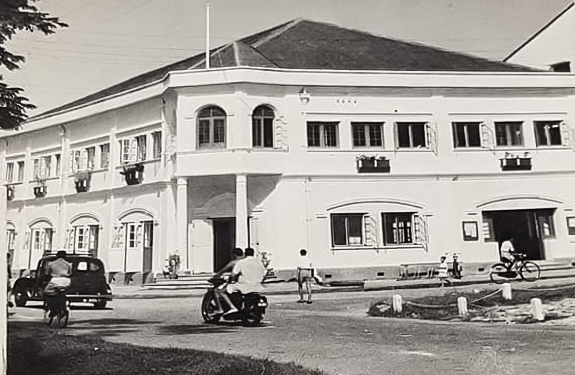
Archive photo taken in the 1970s shows Kuching Municipal Council’s building – popularly known as the ‘KMC’ – at Jalan Khoo Hun Yeang. Local government elections were the ‘political heirloom’ left by the colonial rule – from the local authorities, people were learning the ropes of self-governing at the grassroots level.
IN a flash, the ownership of Sarawak changed hands. It’s a valuable piece of real estate, after all – in comparative terms, that is.
Acquired in 1842 from the Sultan of Brunei by Captain James Brooke, the former soldier of the East India Company, Sarawak was ruled by him and his relatives for one hundred years. It was conquered and occupied for four years by the Japanese Imperial troops from whom it was saved and briefly administered by the Allied Forces led by the Australians. Then it was finally returned to its rightful owner, Rajah Vyner Brooke. Back for barely a year in his hands, Sarawak was handed on a platter to the British Government on July 1, 1946. And on July 22, 1963, before anybody could say ‘Jack Robinson’, the 46-day-old self-ruling state was merged with the Federation of Malaya, Singapore, and North Borneo on Sept 16, 1963.
That’s Sarawak history in a nutshell.
What the future holds for the Sarawakians in this Federation depends so much on how smart they and their children would behave in terms of managing their precious inheritance – politically, economically, and socially. For better or for worse, the future and fortune of Sarawak lie in their hands.
Heritage gained and lost
Politically, one important ‘pesaka’ (heirloom) left by the colonial government was the local government elections. Local authorities are useful; in the past, they brought primary education to the remote rural areas. They ran maternity and child welfare clinics throughout the colony. From the local authorities, people were learning the ropes of self-governing at the grassroots level.
In this connection, do you not remember hearing about the ‘Nine Cardinal Principles of Government’ – a vestige of colonialism that is worth keeping?
They’re set out in Sarawak Order No C-21 (Constitution) 1941.
Relevant to our present purpose, pay attention to Cardinal Principle Number 8.
Three months before the Japanese troops landed in Miri in 1941, the last Rajah of Sarawak had made an announcement in the following manner: “Now therefore it is met that we should pronounce and declare the principles of government which have actuated our predecessors and ourselves during the 100 years of the rule of the English Rajahs. And we do urge that these same principles which have brought peace and contentment to our people may serve to guide the members the Councils of State who will, hereafter, be responsible for the good Government of Sarawak. Let the Cardinal Principles of the rule of the English Rajahs as set out hereunder therefore be remembered: 8. That the goal of self-government shall always be kept in mind, that the people of Sarawak shall be entrusted in due course with the governance of themselves, and that continuous efforts shall be made to hasten the reaching of this goal by educating them in the obligations, the responsibilities, and the privileges of citizenship.”
Important safeguard
When Sarawak became part of the Federation of Malaysia, the right to legislate for local government including the holding of regular elections, was retained for the state. Indeed, as a safeguard demanded by Sarawak’s leaders at the time, the Inter-Governmental Committee Report (IGC) stipulated that ‘during an initial period after Malaysia Day elections to the State Assembly should be indirect’.
Sadly, this condition of entry for Sarawak into Malaysia, was not honoured.
The activities of the local authorities were meant to be a school for local politicians aiming at ruling the country when it was time for full Independence for Sarawak. For a start, a system of ministerial government was put in place.
Then-Elected District Councillor Tan Sri Datuk Amar Stephen Kalong Ningkan was appointed the Chief Minister of Sarawak. He formed his team of ministers, mostly elected councillors, to manage the affairs of Sarawak.
They paved the way, but there were many obstacles in the way.
How was this right to conduct local government elections lost?
No one has owned up taking out an essential ingredient of good governance at the ground level. However, one gets snippets of information from the writings of the academia. No one now walking in the corridors of power has come up with the reason and rationale for smothering the grassroots democracy in Sarawak.
Nor is there any interest shown by the present generation of politicians in the state to revive the elections, calling themselves patriots!
The first ministerial form of government was showing signs of quality leadership in the elected councillors – articulate, with down-to-earth and people-centred policies, irrespective of race or religion.
This did not miss the attention of certain federal politicians, many among them were advocates of a quasi-unitary federation rather than a loose federation. Their concern was that these jungle-dwelling legislators would not toe their line once they had learnt the ropes of politics of federalism.
Relate this to what the Chairman of the Cobbold Commission had feared: “If any idea were to take root that Malaysia would involve a ‘take-over’ of the Borneo territories by the Federation of Malaya and the submersion of the individualities of North Borneo and Sarawak, Malaysia would not, in my judgement, be generally acceptable or successful.”
Lord Cobbold had said it. Prove him wrong.
Still on local government elections
In 1965, the federal government appointed a Royal Commission of Inquiry (RCI), under the chairmanship of Senator Datuk Athi Nahappan, to look into the workings of local authorities in Peninsular Malaysia.
Although one finding was in favour of district elections, our leaders in the federal government in 1970s and the 1980s had succumbed to pressure from the advocates of a unitary federation.
Unless and until the budding politicians of Sarawak and Sabah revive local government elections, we would soon forget about giving the rural electorate a chance to pick the councillors of their choice.