


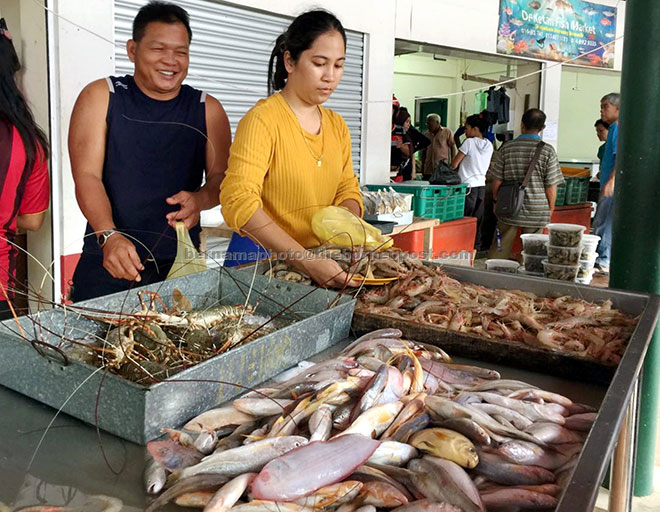

Bernama file photo shows a fresh seafood stall. Fresh fish and seafood were among items found to be cheaper in East Malaysia.
KUCHING (April 16): Not all goods sold in Sarawak and Sabah are more expensive compared to those sold in Peninsular Malaysia, said Minister of Domestic Trade and Consumer Affairs Dato Sri Alexander Nanta Linggi.
In a statement issued yesterday, he said an analysis of prices showed that basket values for fresh fish, fresh seafood, as well as liquid or condensed milk in Sarawak and Sabah were much cheaper than in the peninsula.
“Sabah also recorded cheaper basket values for other products made from grains, fresh meat, fresh and re-mixed milk, fresh vegetables, potatoes, and sweet potatoes, compared to the peninsula. Sarawak, on the other hand, showed cheaper basket values for coconuts and beans and dried/pickled vegetables compared to the peninsula.
“Based on this analysis, Sarawak, Sabah, and the peninsula did not show a significant price difference gap as the baskets in Sabah and Sarawak were offset by cheaper goods compared to the peninsula. Therefore, all consumers should take this opportunity to practice smarter spending,” he added.
The December 2020 Consumer Price Index (CPI) report showed that both regions did not record the highest average price — with Sarawak in sixth place, while Sabah was at 15th place in terms of basket price values.
(For the freshest news, join our Telegram channel)
Nanta said transportation costs were identified as the main factor that affected the difference in prices for necessities not originating from or processed in Sarawak or Sabah.
Other factors contributing to the price imbalance between Peninsular Malaysia, Sarawak, and Sabah were poor distribution channels, port inefficiency, high handling charges, and inefficient ground transportation, he said.
As such, he said the government has implemented initiatives such as the Sarawak, Sabah, and Labuan Price Standardisation Programme (Port to Port) and the Essential Goods, LPG, and Community Drumming Distribution Programme, aimed at standardising prices in Sarawak and Sabah.
In addition, he said the government has also implemented Cabotage Policy exemptions in Sarawak and Sabah to reduce shipping costs.
“Currently, the government is studying new mechanisms such as creating agro-food hubs in Sarawak and Sabah as one of the efforts to overcome the problem of price differences in the two states. I think this idea should be focused on, taking into account the advantages of Sarawak and Sabah, which have a large area to implement the agro-food hub project,” said Nanta.
In addition, he said efforts to improve the e-commerce platform and improve last mile connectivity for communication and transportation could also reduce the price gap between the peninsula and Sarawak, Sabah, and Labuan, as well as reduce the cost of living in these three areas.
The post Not all goods in East Malaysia more expensive than in Peninsular Msia — Nanta appeared first on Borneo Post Online.