

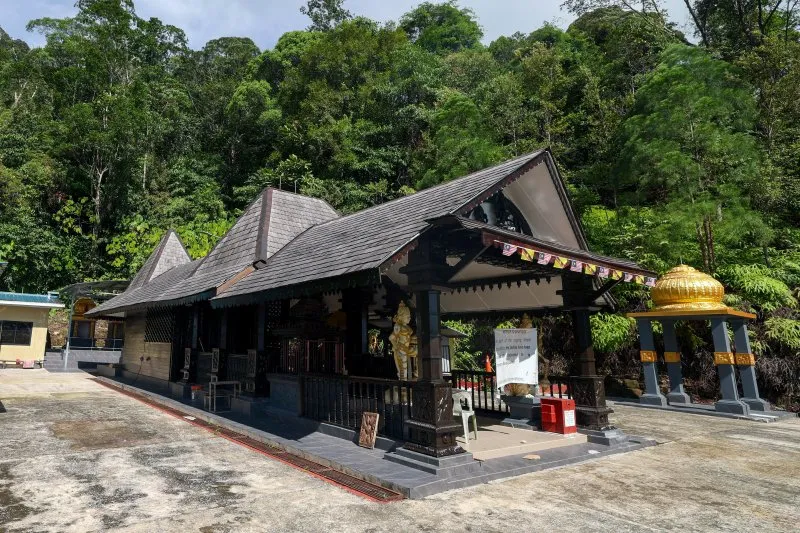
Surrounded by lush greenery on Mount Matang, the Sri Maha Mariamman Temple uses mountain water and solar power for its daily operations. — Bernama pic
Stay updated on the latest news and insights. Subscribe to our newsletter here
 Make Malay Mail your preferred source on Google Giving you news that matter to Malaysians. Make Malay Mail your preferred source when you search for news on Google.
 Giving you news that matter to Malaysians. Make Malay Mail your preferred source when you search for news on Google.
First Published: Saturday, 28 Nov 2026 6:35 PM MYT
Last Modified: Saturday, 28 Nov 2026 6:45 PM MYT
KUCHING, Nov 28 — What began as a simple Google search eventually turned into a calling for this Peninsular Malaysia-born writer to visit a 129-year-old Hindu temple perched atop Mount Matang, about a 30-minute drive from Kuching.
A phone call to the temple chairman led to the discovery of one of Sarawak’s oldest Hindu temples, the Mount Matang Sri Maha Mariamman Temple, which has a unique distinction — it is built entirely from belian, or Borneo ironwood.
Scientifically known as Eusideroxylon zwageri, belian is among the region’s strongest timber species, commonly used in houses, bridges and maritime structures. It is also Sarawak’s official tree.
Temple chairman Vaithilingam Palanisami, 70, said the temple is believed to be the only Hindu temple in Malaysia built entirely from ironwood, dating back to the 19th century during the Brooke era.
“The temple was here from 1897 until 1912. The second White Rajah, Sir Charles Brooke, brought people from India, Kerala, Ceylon (now Sri Lanka) and elsewhere to plant coffee in this area, which was then developed into a coffee estate.
“After 1912, when the estate closed, they also closed the temple and brought the deity down,” he told Bernama.
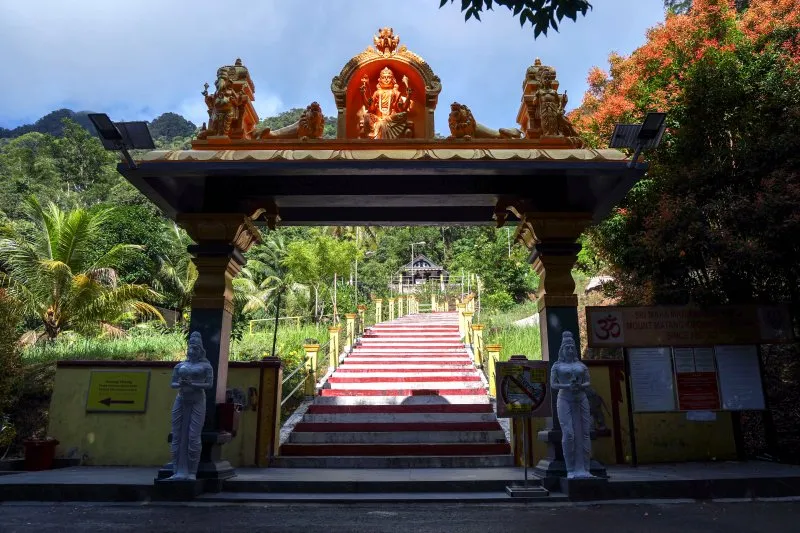
A flight of 108 steps leads visitors to the Mount Matang Sri Maha Mariamman Temple, a historic Hindu place of worship nestled in the hills near Kuching. — Bernama pic
Vaithilingam said the temple remained abandoned for 56 years until 1968, when a Bidayuh-Melanau hunter named Abi Benggali sought shelter there during a thunderstorm.
News of the discovery eventually reached the Indian community, prompting a search for the long-forgotten temple.
“Some Indian youth tried to get some information on whether it was true that there was a temple up there. They asked the older generation, who said, ‘Yes, there was a temple up there, but we don’t know how it looks like now.
“The hunters then offered to bring them up here. They found the temple and after that, cleared the area and started prayers according to Indian rituals,” he said.
Vaithilingam said prayers were conducted on a small scale from 1970 to 2000, before the Indian community undertook restoration work, retaining the original design and materials.
Situated on the slopes of Mount Matang, the temple can be reached by hiking or using authorised transport along a narrow, steep access road.
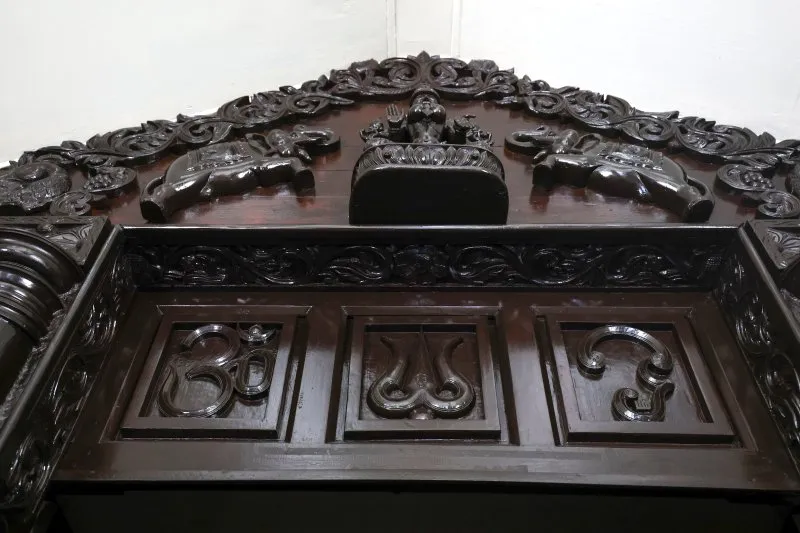
Intricate ‘belian’ woodwork is a defining feature of the Mount Matang Sri Maha Mariamman Temple, which has survived decades of abandonment and subsequent restoration. — Bernama pic
Upon arriving at the foot of the temple in Vaithilingam’s trusty 4WD vehicle, the writer was greeted by a flight of 108 steps leading to the main altar, which is currently undergoing refurbishment. The deities have been temporarily placed at an adjacent altar, with the works expected to be completed within two months.
However, the temple remains open to the public for prayers daily from 8 am to noon and is closed during evening prayer except for special Hindu occasions.
Visitors can also explore the nearby Gunung Matang Indian Heritage Centre, which houses artefacts and offers further insights into the temple’s history.
Beyond its distinctive ironwood structure, Vaithilingam said the temple also relies on natural resources for its daily operations — water comes from the mountain, while electricity comes from solar energy.
“Our monthly maintenance costs are about RM5,000, particularly for the priest and caretaker. So far, we have been able to meet these expenses through funds and donations,” he said.
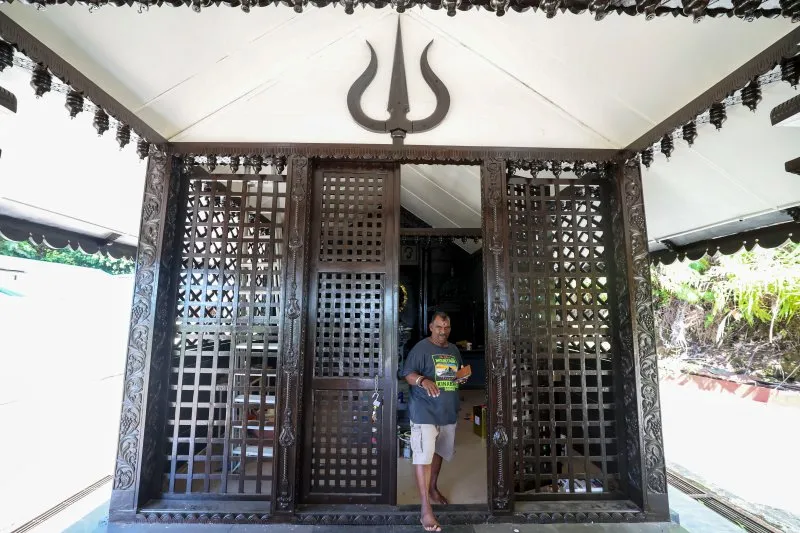
The Mount Matang Sri Maha Mariamman Temple near Kuching, Sarawak, dates back to the 19th century and is renowned for its construction using ‘belian’, or Borneo ironwood. — Bernama pic
Devotees wishing to spend the night at the temple for special prayers can also make use of a homestay located next to the heritage centre.
A former Public Works Department driver, Vaithilingam is a fourth-generation Malaysian Indian born and raised in Sarawak. He has been visiting the temple regularly for the past 50 years.
The temple is managed by the Sri Maha Mariamman Temple Association in Kuching, with Vaithilingam having served as its chairman for almost 10 years.
Located within the Tupong state constituency, the temple stands as a reminder of Sarawak’s diverse cultural heritage and the importance of preserving historical landmarks for future generations, as the state heads to the polls on December 12. — Bernama