

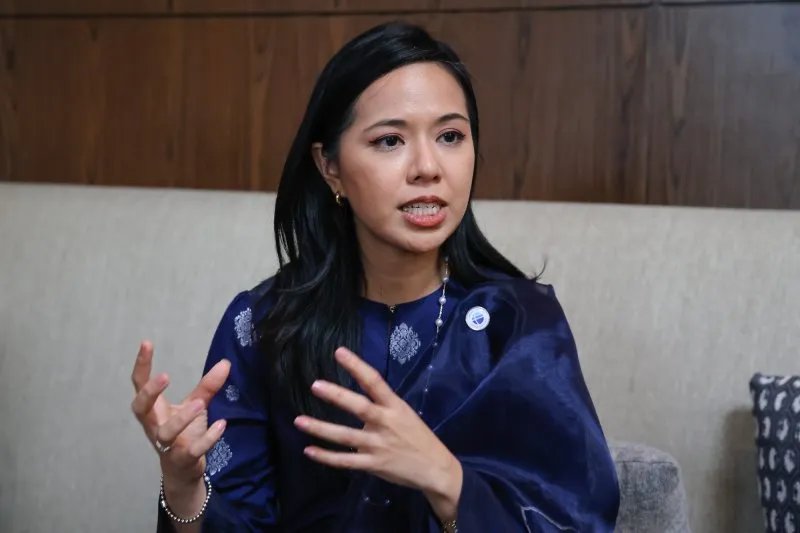
Executive director of Fulbright Malaysia (Malaysian-American Commission on Educational Exchange), Aeti Amirah Abdullah started her career as a fashion writer before joining Universiti Malaya as an international relations officer, where she helped expand the university’s international partnerships, facilitate academic exchanges and promote scholarships. — Picture by Yusof Isa
Stay updated on the latest news and insights. Subscribe to our newsletter here
 Make Malay Mail your preferred source on Google Giving you news that matter to Malaysians. Make Malay Mail your preferred source when you search for news on Google.
 Giving you news that matter to Malaysians. Make Malay Mail your preferred source when you search for news on Google.
By Soo Wern Jun
KUALA LUMPUR, Nov 26 — When Aeti Amirah Abdullah graduated with first-class honours in mass communication and received the Vice-Chancellor’s Award in 2014, she thought it was finally time to pursue her long-held ambition of studying abroad.
She had received offers from several overseas universities, but without a scholarship, the cost was beyond her reach.
“I always wanted to study abroad. But I feel like I didn’t have the confidence back then to even apply for scholarship,” she told Malay Mail.
Raised by a single mother, Aeti was unwilling to place the financial burden of overseas studies on her family.
She had received a Public Service Department (JPA) scholarship for her undergraduate studies locally. However, when she began considering postgraduate options, she recalled that scholarships from JPA and Majlis Amanah Rakyat (Mara) had been cut back, particularly for students pursuing the social sciences.
The period also coincided with changes to government overseas sponsorship. In 2014, reports emerged that JPA had withdrawn its overseas scholarship option for non-bursary students, citing a lack of funds. In 2016, the government cut 744 overseas JPA bursaries, with affected students redirected to local universities.
An ambition on hold
Instead of giving up, Aeti started working.
Trained in communications, she began her career as a fashion writer before joining Universiti Malaya as an international relations officer, where she helped expand the university’s international partnerships, facilitate academic exchanges and promote scholarships.
It was through this work that she developed an interest in international education.
“I just fell in love with being in education,” she recalled.
She went on to work with the British Council and the US Embassy, where she served as country coordinator for EducationUSA.
There, she was struck by the range of scholarships, financial assistance and advisory services available to students wishing to study in the United States, many of which she had not known about when she was first looking to study abroad.
She made it her mission to bring these opportunities to a wider audience. Through partnerships with the Education Ministry and other stakeholders, her efforts contributed to an increase of about 250 per cent in student outreach and engagement, especially among students in public schools and communities with fewer resources.
Her career later took her to the University of Rochester, where she managed partnerships across South-east Asia and international student recruitment.
Yet the more experience she gained, the more conscious she became of the limits of her knowledge of education.
“I really wanted to learn more about the theory behind the things that I had been doing day in and day out. I also wanted to learn about the frameworks and the language to articulate what I had been observing and practising,” she said.
Aeti applied for the Yayasan Khazanah scholarship twice before finally securing it in 2023.
It allowed her to pursue a master’s degree in education at the Harvard Graduate School of Education, where she spent a year studying education policy.
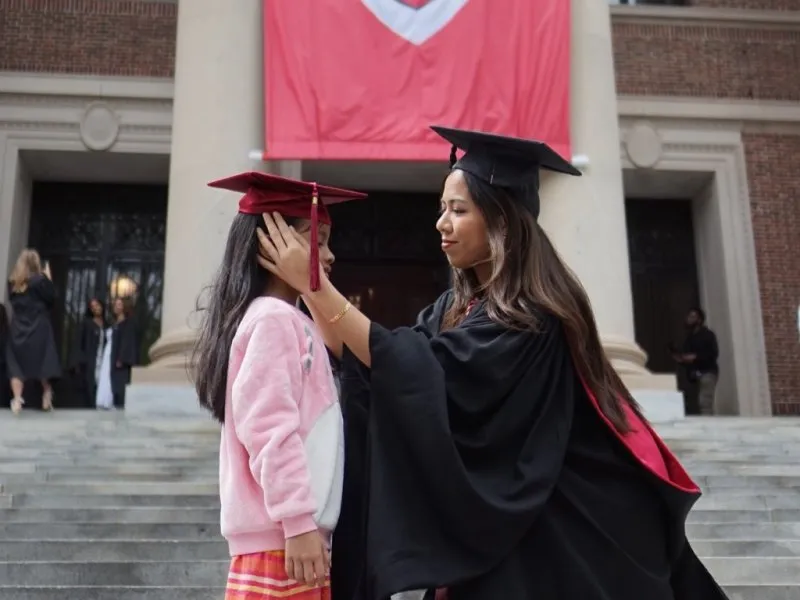
Aeti Amirah Abdullah with her six-year-old daughter — she says family is her strongest support system throughout her struggles — Courtesy of Aeti Amirah Abdullah
Making opportunities visible
Her time at Harvard gave her more than an academic qualification. It broadened her understanding of education and helped her see how access to opportunities often depends on the information and connections people have — some are well placed to find them, while others may not know they exist.
That idea now shapes her work as executive director of the Malaysian-American Commission on Educational Exchange (MACEE), which administers the Fulbright programme and facilitates educational and cultural exchanges between Malaysia and the United States.
Appointed in late 2025, Aeti said she saw the role as a chance to make international education more accessible, particularly to Malaysians who may not know where to look or how to apply, or who might not otherwise consider studying or gaining experience abroad.
Established in 1963, MACEE has more than 3,000 Malaysian and American alumni.
Studying in the United States also showed her how different educational environments shape the way students learn and express themselves.
“Especially in the US, you are encouraged to be more hands-on and go outside of your comfort zone, and it is very disorienting at first,” she said.
She recalled being used to a learning environment where students were expected to listen to teachers and follow instructions, whereas at Harvard she was encouraged to speak up, share her views and take a more active role in discussions.
Although her programme lasted only a year, she attended several conferences, including the SDG Action Weekend at the United Nations headquarters in New York, travelled across the country and met people from different parts of the world.
“When you go there, you’re the minority, and when you’re the minority, you learn a lot of things, you see things differently. And I feel like that’s why more people should go abroad and open up their perspective,” she said.
Beyond scholarships
Before joining MACEE, Aeti was an education advocacy manager at Yayasan Hasanah, where she managed Program Anak Kita, a nationwide learning recovery initiative involving civil society organisations and universities.
The programme brought together 10 organisations and universities to carry out 13 interventions, and by March 2025 had reached more than 83,000 students across 2,542 schools.
Working closely with the Education and Finance ministries also gave her the chance to visit schools and see the challenges faced by students and teachers.
“I think you have to know what’s happening on the ground for you to shift policy because if you’re just shifting policy without understanding the context, it won’t work,” she said.
That experience informs her approach at MACEE, where she wants educational exchanges to benefit not only individuals but also institutions and the wider education system.
She cited programmes that send Malaysian secondary school teachers to the United States for six weeks of professional development, including exposure to areas such as special education, which she believes needs greater attention in Malaysia.
Aeti said she hoped to align MACEE’s programmes with the country’s new education plan, higher education plan and the 13th Malaysia Plan, so that the benefits of exchanges could extend beyond those taking part.
“I don’t just run the commission as a scholarship provider.
“I want to translate the scholarships and resources to contribute to nation-building,” she said.
For someone who once lacked the confidence to apply for overseas scholarships, Aeti now hopes to make it easier for others to find their way.