


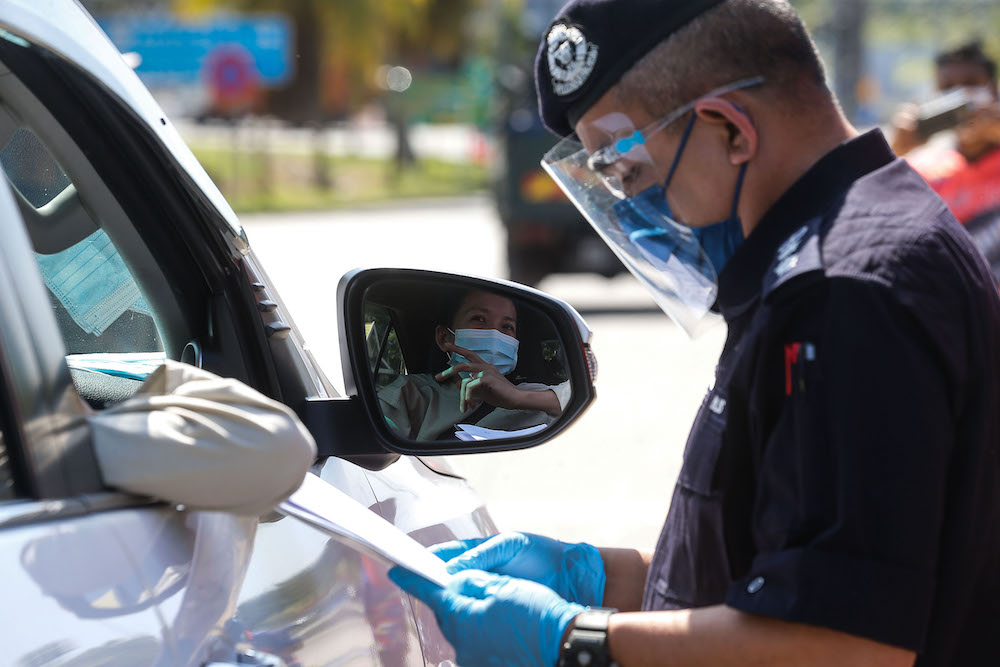
The Bintulu Division Disaster Management Committee has confirmed that essential workers no need to undergo PCR tests for movement within Bintulu division. — File photo by Sayuti Zainudin/Malay Mail
BINTULU (June 4): There is no need for essential service workers to undergo PCR tests for movement within Bintulu division, said Bintulu Division Disaster Management Committee (BDDMC) chairman Jack Aman Luat.
He made this clarification when prompted to respond to concerns raised by some truck and lorry drivers who claimed they were stopped today at a roadblock near Bintulu Airport to produce PCR test results or else they were not permitted to pass through despite having company-issued letters as per the standard operating procedure (SOP).
“For movement within Bintulu division, there is no need to take swab test,” Jack said in a brief Whatsapp response when contacted by The Borneo Post today.
Confirming this was Bintulu police chief Supt Zulkipli Suhaili who said that there was no need to undergo swab tests for movement within the division.
“Our instruction is that within Bintulu (division), there is no need for swab tests.
“For movement of lorries, no need for drivers to take swab tests within Bintulu Division.
“We are very clear on this one matter and there is no issue,” he said when contacted.
When asked about the claims by the truck and lorry drivers that they were stopped at the roadblock near Bintulu Airport and asked to produce their PCR test results, Zulkipli said he was not certain and would check on it.
Separately, Sarawak Police Commissioner Datuk Aidi Ismail had said that essential service workers do not have to apply for the inter-district travel permit from the police to travel to work.
Meanwhile, the essential services in Sarawak comprises food and beverage operators, roadside hawkers, mobile stalls, food courts, hawker centres, roadside food stalls or kiosks, restaurants, food stalls, food premises and food trucks.
Also allowed to operate are public markets, wet markets, wholesale markets, and ‘tamu’ under the jurisdiction of local authorities.
For outlet stores, hypermarkets, shopping malls, premises supplying essential goods and food are allowed to open.
Sectors that are allowed to operate include professional bodies, insurance, takaful service, and community credit service (pawnshops only), financial and banking services, courts and legislative services, logistics, courier and post services, solid waste and sewage management, businesses related to the defence and security sector, manufacturing industry, building and repair of ships, and timber industry.
Hotels and accommodation premises are allowed to operate for the purpose of quarantine, isolation, and essential services, but not for tourism.
Plantation, agriculture, and fishing sectors; land, air, and sea services (including e-hailing and food delivery services); as well as the construction and renovation sector are also allowed to operate.
Other sectors allowed to operate are prisons, temporary detention centres, immigration depot, one-stop centres, lock-up, electrical and energy service, government and public service, ports and airports, sectors involved in selling lubricants and fuel (including refuelling stations), telecommunications services (no retail service and counters allowed), water, food preparation service and supply, as well as broadcasting and information.
Governmental and private hospitals, clinics, health offices, animal clinics, pharmacies, and shops selling medicines are allowed to operate.