


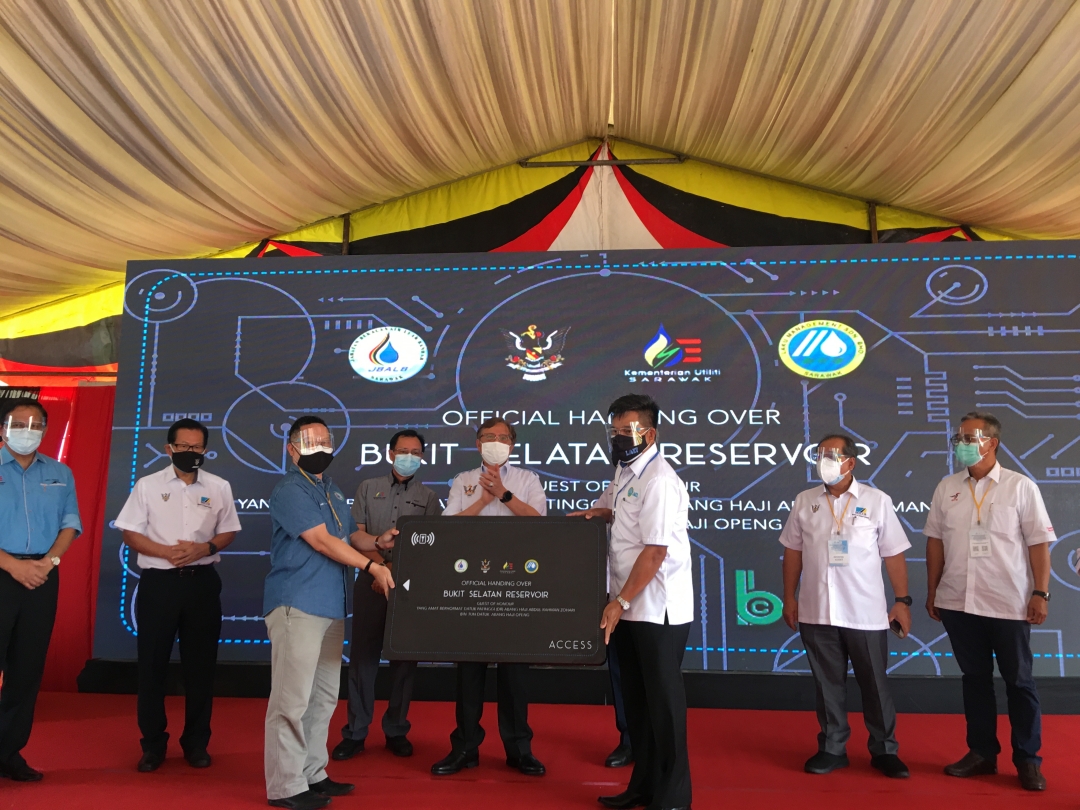
Abang Johari (fourth left) witnesses the handing-over of Bukit Selatan Reservoir from JBALB director Chang Kuet Shian (fifth left) to Laku CEO Daniel Punang. – Photo by Jenifer Laeng
MIRI (Aug 19): The Sarawak government is committed to investing in water and electricity supply to achieve its target of becoming a developed state with a gross domestic product (GDP) of RM280 billion by 2030.
Chief Minister Datuk Patinggi Abang Johari Tun Openg said for Sarawak to achieve immense economic growth, it has to diversify its economic activities.
“One is power (electric supply), secondly is water. Without water, without power, you cannot move. These are all new ways and thank God, we have the means to transform (our economy), and we have the people with talent (to do it).
“There is a positive correlation between increased national income and the proportion of population with access to improved water supply,” he said when officiating at the ground breaking ceremony of Lembaga Air Kawasan Utara (Laku) head office and handing-over of Bukit Selatan Reservoir here yesterday.
Abang Johari quoted World Bank Report where it said that a 0.3 per cent increase in investment in household access to safe water is associated with a one per cent increase in GDP.
“If we give 10 per cent investment, you multiply it. That is why we have a target that by 2030, our GDP which is RM130 billion in 2019 (will increase) to RM280 billion in 2030 and that Sarawak will become a developed state. We have to invest in these – water supply, electricity and the other one is education (talent development),” he said.
The Chief Minister also pointed out that with the state’s water supply grid ready by 2025, it would become a commodity for the state government.
He said by 2025, the state’s three water supply entities; namely Kuching Water Board, Sibu Water Board (central) and Laku, will become a unit under a single agency like Sarawak Energy.
“This would mean that the infrastructure management will have a central data. For example, if there is a new pipe, it would be keyed into the data so that we know where it is located.
“Like what happened in Kabong, there was a leak but we did not know where the pipe was because there is no data. We must have a central data,” he pointed out.
With the new state water supply grid in place, Abang Johari said Sarawak would also determine the water tariff so that it would not become a burden for the people.
He also pointed out that if Sarawak is able to manage its own water supply well, there may be excess of supply.
“If we were to have excess supply of water, we can share with our neighbours. Today, we supply electricity to west Kalimantan (Indonesia) and the other week with Sabah.
“That would be our common dream, provided that Gabungan Parti Sarawak (GPS) would still be the government,” he said.
A total of RM4 billion was allocated for 321 water supply projects aimed at resolving the water supply reliability issues in water stressed areas and providing potable water supply to those without access to this basic amenity.
On the Covid-19 situation in the state, Abang Johari said Sarawak became the first state in Malaysia to have achieved 80 per cent herd immunity, but reminded Sarawakians to continue complying with the Covid-19 standard operating procedures (SOPs).
“I congratulate Sarawakians because we have achieved the 80 per cent herd immunity. We have our own way (to speed up vaccination), and even though there is still infection, they are mostly category one and two. Hospitalisation and ICU (intensive care unit) (admission) have decreased, and we hope that it will continue to come down. Nevertheless, we have to maintain the SOPs,” he said.
At the function, Abang Johari performed the ground breaking ceremony of the new Laku head office and witnessed the handing over of Bukit Selatan Reservoir from Sarawak Rural Water Supply Department (JBALB) to Laku.
The eight-storey Laku head office sits on high elevated ground of Bukit Selatan Miri and is expected to be completed in June 2023. It will serve as the corporate centre where important functions of Laku Management are coordinated.
The construction of Bukit Selatan Reservoir began on July 2018 and was completed in July 2021. The project costing RM24 million included the construction of 27 million litres of reinforced concrete reservoir with inlet and outlet chambers, 6,170 metres of steel pipeline, external works that include the road, car parks, surface drainage and slope protection and the mechanical and electrical works required for the reservoir.
The reservoir serves as a balancing tank to improve water supply and serve the increasing population of Miri City, Jalan Luak Bay and Jalan Tanjong Lobang areas.
It increases the storage capacity of potable water in Miri City from the current 42 million litres to 69 million litres, thus increasing the water reserve for Miri City from 6.6 hours to 10.7 hours in case of unfortunate incident of water production stoppage.
Among those present at the function were Minister of Utilities Dato Sri Dr Stephen Rundi Utom, Minister of Transport Datuk Lee Kim Shin, State Secretary Datu Amar Jaul Semion, Assistant Minister of Tourism, Arts and Culture Datuk Sebastian Ting, Assistant Minister of Welfare, Community Wellbeing, Women, Family and Childhood Development Datuk Rosey Yunus, Assistant Minister of Local Government and Housing Datu Dr Penguang Manggil and Laku chairman Datuk Nelson Balang Rining.