


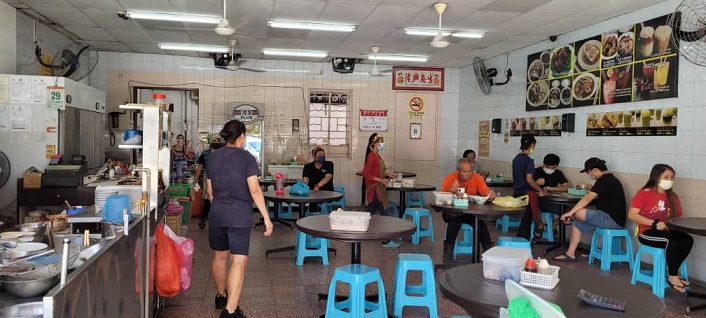
Business is picking up at Kedai Kopi Melanian 3 when the dine-in ban was lifted on Tuesday.
KOTA KINABALU: The State Government’s move to allow dine-ins is well-received by eateries.
Madam Lui, who operates Kedai Kopi Melanian 3 at Jalan Pantai, said business was definitely better when dine-in was allowed compared to providing takeaway only.
The coffee shop is famous for sang nyuk mian, or pork noodle soup, but also sells other rice-based dishes.
Lui said the shop was only able to retain 30 per cent of the business when dine-in was banned when the Movement Control Order 3.0 (MCO 3.0) was imposed on June 1.
“Perhaps customers prefer not to purchase noodle soup for takeaway. What they do not know is that we sell rice dishes as well,” she said when met today.
Chief Minister Datuk Seri Panglima Hajiji Noor has announced that Sabah would implement Phase One of the National Recovery Plan (NRP) beginning June 29, which involved revision to the standard operating procedure (SOP) to allow dine-in at restaurants, coffee shops and hotels.
She said the coffee shop used to place 16 tables at the premises, which can seat four patrons each, before the Covid-19 pandemic.
“Today, we only place 11 tables with a maximum of two customers each.”
She also hoped that the State Government would release the SOP as soon as possible as eatery operators were anxious to know the rules they have to observe.
“I have heard worrying rumours about coffee shops being ordered to close and issued compound in Bornion Centre and Damai this morning, which turned out to be fake.
“We hope that the latest SOP will be released as soon as possible to clear up any confusion.”
Meanwhile, Waris Samidi, 58, who has operated a soto stall with his wife at Jalan Pantai for 20 years, was relieved that dine-in was now allowed.
He said his stall could hardly make enough profit to pay for workers’ salary, rent and other financial commitments from takeaways alone when dine-in was banned.
He said the revenue he made from takeaways during MCO 3.0 was less than 30 per cent of his usual business.
As business plunged, Waris said he had no choice but to put his four workers to work on rotational basis.
“Two of my workers will work this week, and the other two will replace them the following week. I also sympathize my workers, some of them have to travel far to work and some have family to feed,” he said.