


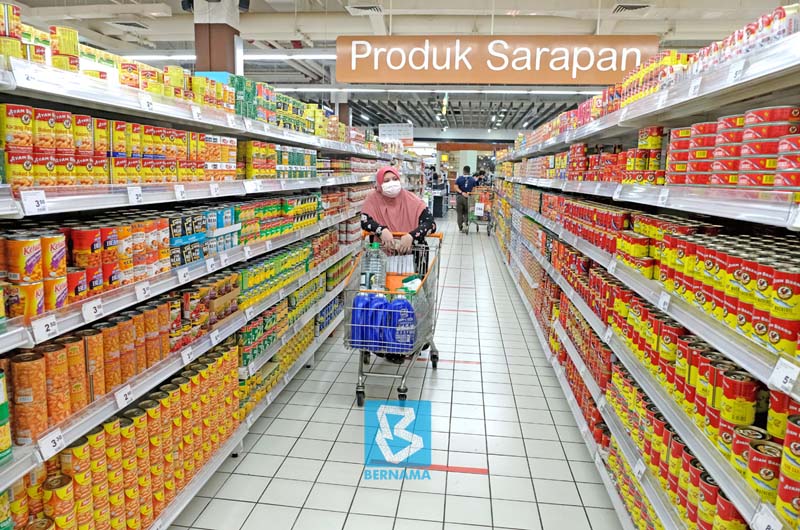
Analysts see further downside to Malaysia’s economic growth which would likely to beat down its CPI growth further but a successful vaccine rollout in the country will likely to improve sentiments and encourage consumer spending. — Bernama photo
KUCHING: Analysts project high inflation growth over the next several months as the base effect evens out and expects little reason for stronger consumer price index (CPI) momentum over the next one to two quarters.
RHB Investment Bank Bhd (RHB Investment) recapped that April 2021 inflation rose strongly to 4.7 per cent year on year (y-o-y) from 1.7 per cent in the month prior, continuing its upward trajectory following the low base effect.
“April inflation data highlighted what we had been largely expecting which is the full blown impact from the low base effect,” the research firm said.
“In fact, we would likely to see continued high inflation growth over the next several months as the base effect evens out.
“However with this in mind, we see little reason for stronger CPI momentum over the next one to two quarters.
“The current weak economic growth coupled with the anticipated tighter lockdown under MCO3.0 could likely keep demand-pull pressures muted as the slack in the labour market remains.”
On core inflation (taking out the volatile component of food and fuel), RHB Investment noted that this showed a soft underlying price pressures.
“Core inflation for April grew by 0.7 per cent y-o-y which was among one of the lowest growth since the abolishment of the Goods and Services tax in 2018-2019.”
With the possibility of a tighter measures following the rise in Covid-19 cases, the research firm sees further downside to economic growth which would likely to beat down price growth further.
“In addition, the government’s fixing of the domestic fuel prices limits any upside from the rising commodity prices.
“While this mitigates a major source of price pressures, the secondary effects from the increase of other commodity prices as well as imported goods could still cause a rise in prices.
“If anything, the increase could likely be absorbed by retailers.”
RHB Investment highlighted that on the plus side, there could be some support to demand-pull pressures through the recent stimulus under the i-Sinar programme.
“A total of RM56 billion has so far been approved which likely explains the preliminary increase in retail sales seen in March.
“Further, the robust growth in the trade-oriented segment of the economy, reflected by strong exports and the rise in the capacity utilisation at 85 per cent in 1Q21, could be offsetting some of the weak CPI momentum.”
Meanwhile, the research arm of MIDF Amanah Investment Bank Bhd (MIDF Research) recapped that inflationary pressure was largely muted in current year 2020 (CY20) due to weak demand, low crude oil prices especially in the first half of CY20 (1HCY20) and government rebates through the electricity discount bills.
“Although the electricity rebates will continue until June this year, the quantum was lower than what was given last year,” MIDF Research said.
“Generally, apart from the low base effect, inflationary pressures are expected to increase this year on the back of expansionary fiscal and monetary policies, higher commodity prices and returning demand as economy recovers.
“Successful vaccine rollout in the country will likely to improve sentiments and encourage spending.
“Consumers may start to spend on discretionary items on better income prospects.”
According to MIDF Research, blanket withdrawal of i-Sinar could pave way for unaffected or less affected contributors to increase their discretionary spending.
“Furthermore, there are some pro-consumption goodies in the latest PEMERKASA such as one-off RM500 assistance for the Bottom 40 per cent (B40) group who have lost their income and increase in allocation for eBelia e-wallet programme and Bantuan Prihatin Rakyat (BPR).”
In addition, MIDF Research anticipated that Brent prices will continue to hover between US$58 per barrel (pb) to US$65pb at least in the first half of current year 2021 (1HCY21) due to the Organization of the Petroleum Exporting Countries and allies (OPEC+) alliance decision to maintain its current production cut through May 2021.
Hence, the research arm foresees inflation to average at 2.3 per cent y-o-y for this year, compared to -1.1 per cent y-o-y in 2020.