


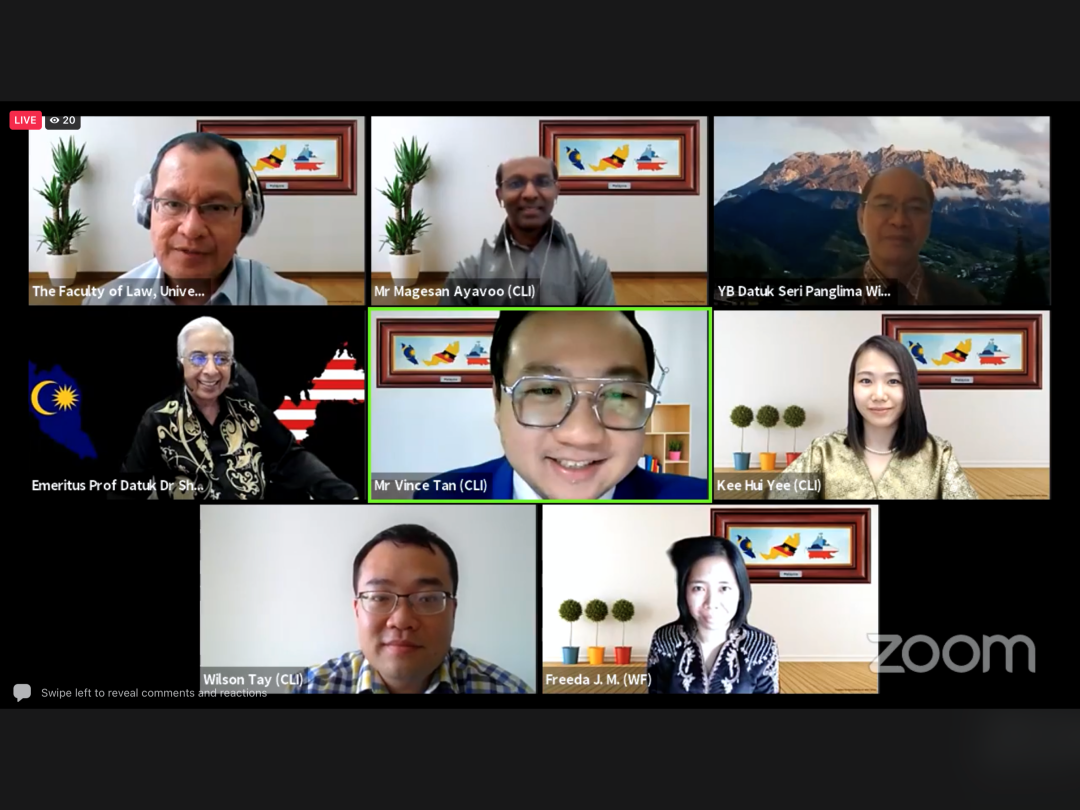
Shad (second row, left) is seen in a screen grab with speakers and participants of the webinar held via Zoom.
KUCHING (Sept 17): There is a need to strengthen institutional mechanisms for regular, non-partisan dialogue between the federal government and Sabah and Sarawak so that the inevitable tensions that are inherent in a federal set-up can be resolved with the least friction, says Constitutional Literacy Initiative (CLI) co-chair Emeritus Prof Datuk Dr Shad Salem Faruqi.
He said the federal government and Peninsular Malaysians must rededicate themselves to the pacts of the past.
“We need to recapture the spirit of accommodation, moderation and compassion that animated the leaders of the Malaysia Agreement 1963 (MA63),” he said at the Constitutional Safeguards for Sabah & Sarawak’s Autonomy Webinar held via Zoom.
Shad, a law professor at Universiti Malaya (UM), acknowledged that there has been a large reservoir of discontent in the country’s sister states of Sabah and Sarawak.
“We need to put our heads and hearts together to defuse the tensions and find just and last solutions,” he said.
During the talk, he brought up several factors which have led to the discontentment from the East Malaysia states.
He said Sabah and Sarawak’s cultural and religious distinctiveness from Peninsular Malaya justified special treatment.
“Both states contribute huge territories (approximately 60 per cent of total land area) of Malaysia. Their combined area is 198,069 sq km, exceeding Peninsular Malaysia’s 131,681 sq km. The coastline of the two states is 2,607 km compared to the peninsula’s 2,068km.
“They have major resources for petroleum, natural gas and timber and yet sadly, despite this massive richness, there are severe problems of poverty and underdevelopment in these states. Such necessities of life as piped water, roads, social and health facilities and internet are not on par with Peninsular Malaysia,” he said.
He also said that due to constitution amendments, federalisation of critical state matters such as water (Act 26/1963) and tourism (Act A885) have taken place.
“Sabah and Sarawak argue that the Territorial Sea Act 2012 reduces their territorial waters from 12 to three nautical miles in violation of Article 2(b). Article 2(b) says that if you want to alter the territories of a state, you must get the consent of the state assembly plus the consent of the Conference of Rulers.
“Sabah and Sarawak said that by reducing the territorial waters, this, in a way, was reducing the territories of both states. So that’s their argument and it has some substance,” he said.
He also touched on native law cases involving land, livelihood and custom which are often heard by a Federal Court panel consisting of Federal Court judges with no Borneo experience.
“So there is a lot of unhappiness that West Malaysian judges decide native land cases and native customary cases even though they are not familiar with the tradition and customs in the culture of Sabah and Sarawak.
“But I have to point out that not all West Malaysian judges think like that as there are some scintillating judgement from these judges recognising the rights of Sabah and Sarawak and the rights of the natives because they say native land is not just land.
“It is part of their livelihood and livelihood is part of life protected by Article 5(1) of the Federal Constitution which says no person shall be deprived of his life or personal liberty save in accordance with law,” said the constitutional expert.
Shad said 58 years down the road, not all is well with Sabah and Sarawak’s relationship with the centre.
“Many areas of Sabah and Sarawak’s autonomy have suffered retreat due to constitutional, political, social and religious developments.
“What can be done to douse the embers of controversy and to rebuild or repair the bridges of friendship and tear down the walls of separations?”
He said leaders of the federal government must recognise that Sabah and Sarawak’s restiveness is real and must be addressed.
“A thorough study of constitutional, legal, financial and political instruments needs to be undertaken.
“This Constitutional Literacy Committee of UM and the Bar basically seeks to achieve this purpose to give our citizens a clearer understanding of what our documented destiny provided,” he said.
He also said that while the MA63 Committee formed by the government in 2018 and 2020 made some progress, more still needs to be done.
The Constitutional Safeguards for Sabah & Sarawak’s Autonomy Webinar, held in conjunction with Malaysia Day, was organised by CLI in collaboration with the Bar Council and UM’s Faculty of Law as well as the support of non-governmental organisation, Wisdom Foundation.
Wisdom Foundation executive chairman Datuk Seri Panglima Wilfred Madius Tangau, who is also Sabah’s Tuaran MP, and CLI member Kee Hui Yee also spoke at the virtual event.