


An artistic rendition of one traditional form of Indigenous bearded pig hunting. Artwork by Amy Koehler, in collaboration with Vanielie Terrence Justine and David Kurz.
KOTA KINABALU: African Swine Fever (ASF) is a lethal virus that has caused mass death of domestic and wild pigs in Sabah over the last nine months.
The virus has hurt pig farms and caused collapse in wild bearded pig populations around the state, and ASF is also likely to be harming Indigenous communities who rely on bearded pigs for food and cultural traditions.
New research published this week in the journal People and Nature shows some of the ways that bearded pigs still play important cultural and dietary roles in Indigenous Kadazandusun-Murut (KDM) communities in Sabah.
An international research team from Malaysia, the U.K., and the U.S. came together to study the ways that oil palm expansion has affected the millennia-old hunting practices of the largest Indigenous group in Sabah, the KDM peoples. The team was made up of researchers from the Universiti Malaysia Sabah, Sabah Parks, Danau Girang Field Centre, Sabah Wildlife Department, Cardiff University, the University of Queensland, and UC Berkeley.
The research team interviewed KDM hunters in Sabah, asking them about their hunting motivations and practices. They found that KDM communities still hunt bearded pigs for some of the same reasons that they have in the past — e.g., food provision, recreation, pest control and gifts for cultural celebrations such as weddings and family gatherings.
For some of the hunters interviewed, bearded pig meat was important for food security. When asked why he hunts, one respondent said simply, “It’s a matter of survival.”
Another hunter said he learned from his father that, “This is our life. We live in the forest; this is our food.”
A third hunter concluded, “We cannot leave the pig.”
Some hunters also emphasized the importance of the bearded pig for their cultural traditions. Bearded pig meat is frequently shared at festivals, birthday parties, and other celebratory events.
In the study, over half of the respondents (54%) said that gift-giving of the meat was a motivation to hunt.
One hunter even went as far as to say, “The bearded pig is our tradition. For celebrations you only use the bearded pig.”
However, there were also some differences with modern KDM hunters as compared to the past; for example, now more hunters pursue pigs in oil palm plantations, not just in forests. With oil palm being so common in Sabah, more pig hunters are heading to industrial and smallholding oil palm plantations to find them. For example, as part of this shift, several hunters in the study reported that hunting in oil palm is easier than in forests, with some saying that their hunting style involves more waiting rather than active searching for pigs. Oil palm therefore seems to be changing some of the ways that KDM hunting takes place.
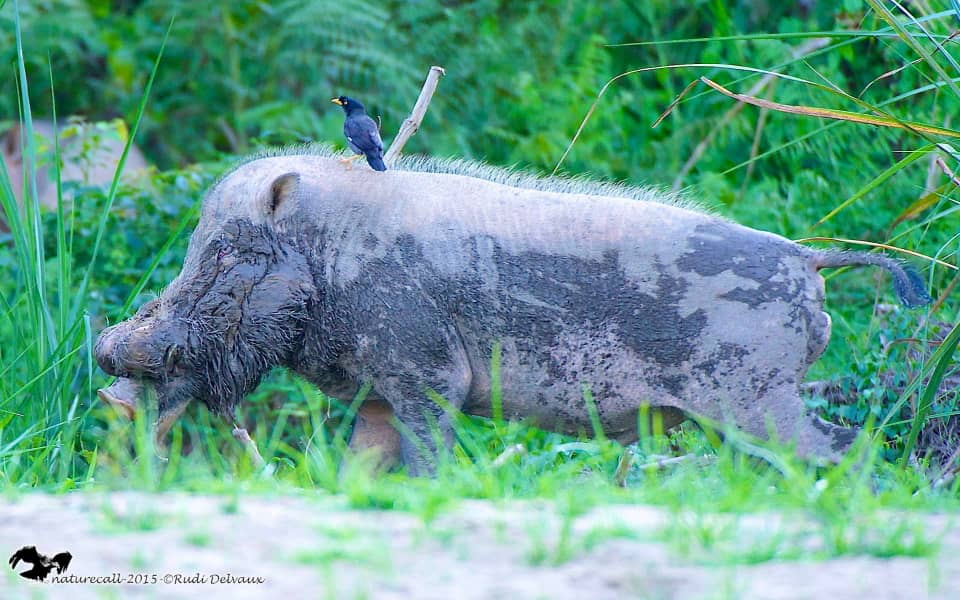
The deadly sweep of ASF through Sabah has killed almost all bearded pigs in some places, leaving populations close to extinction in those areas. At times over the last year, forests have even been reported to smell of the stench of rotting bearded pig carcasses.
As a result, the lack of pigs threatens the health of the forest, as well as food security and cultural traditions in some parts of the state.
However, there is still hope for a recovery of bearded pigs. Professor Benoit Goossens, a co-author on the study and the director of Danau Girang Field Centre, expresses his optimism: “We have evidence collected from camera traps in several protected areas that some bearded pig individuals have survived, although the numbers are extremely sporadic. The species is very resilient, and its reproductive rate is high with a female able to produce between three and 10 piglets per litter.
“We can therefore expect that if some individuals survived the outbreak, the population could bounce back in a few years.”
“If the pigs can make a comeback, it will be great news for bearded pig conservation and KDM cultural traditions” said Goossens.
Dr Fiffy Hanisdah Saikim, a co-author on the study and a Senior Lecturer and Researcher at the Universiti Malaysia Sabah, concludes: “The bearded pigs reflect the peoples of Borneo’s relationship with their rainforests, as well as their desire for a sane coexistence with all the forest’s living animals and a responsible use of its resources. This animal is much more than simply game for the people of Borneo. The bearded pig is a unique creature that bears witness to both ecological and cultural keystone species.”
The authors dedicated their work to the late Peter Malim, an advocate for wildlife conservation in Sabah for many years.