

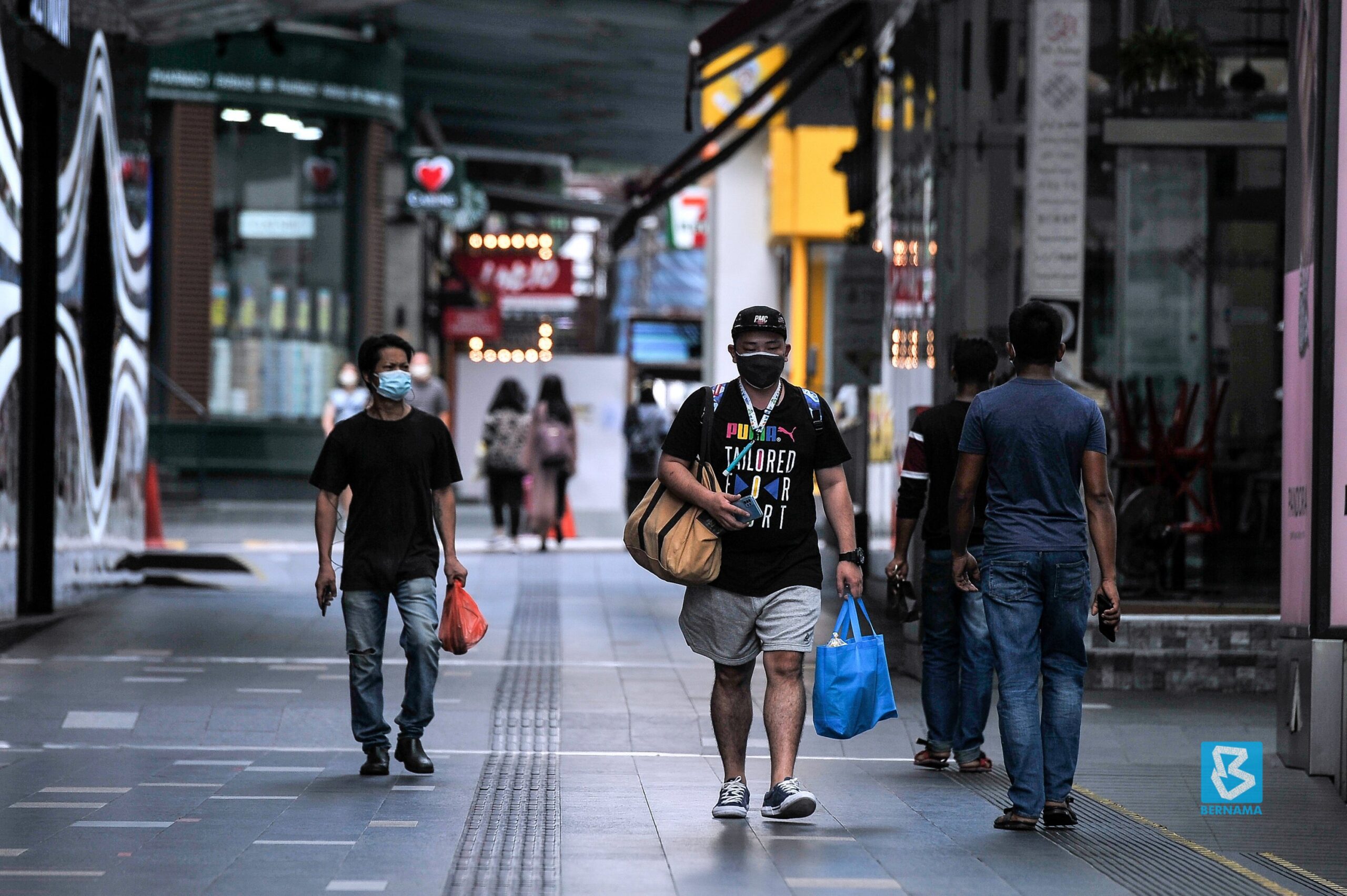
No political changes are expected with the appointment of the new prime minister since such a change will affect current economic policies, recovery plans, and vaccination progress, market observers. — Bernama photo
KUALA LUMPUR (Aug 23): No political changes are expected with the appointment of the new prime minister since such a change will affect current economic policies, recovery plans, and vaccination progress, market observers said today.
UOB Malaysia senior economist Julia Goh said the bank expects most economic and social sectors to reopen by the fourth quarter of 2021 (Q4 2021), paving the way for a rebound in economic growth, supported by a gradual normalisation of economic activities and positive spillovers from external demand.
“We maintain our full-year gross domestic product outlook of 4.0 per cent for 2021 compared to Bank Negara Malaysia’s forecast of between 3.0 per cent and 4.0 per cent, and expect the overnight policy rate to stay at 1.75 per cent for the rest of the year,” she said in a note today.
On Friday, the Yang di-Pertuan Agong Al-Sultan Abdullah Ri’ayatuddin Al-Mustafa Billah Shah named Datuk Seri Ismail Sabri Yaakob as the nation’s ninth prime minister.
Goh said the next hurdle would be the tabling of a motion of confidence in the new PM when the Parliament reconvenes on Sept 6, where the members of parliament can publicly state their stand on the new PM and government to prove that he has the majority support.
Meanwhile, she noted that Malaysia has one of the highest numbers of vaccinated individuals.
Based on the vaccination timeline disclosed in July, almost all states are expected to have 40 per cent of the adult population fully vaccinated by end-August, and the Covid-19 vaccination programme will be ramped up to ensure that all Malaysian adults are fully inoculated by October.
Goh said OUB Malaysia would continue to monitor the renewed external uncertainties following the resurgence of Covid-19 in some major countries such as the United States and China, the expected US Federal Reserve’s quantitative easing later this year, and the pace of China’s economic slowdown.
UOB Malaysia’s opinion was echoed by CGS-CIMB Securities, where it noted that Ismail Sabri’s appointment represents the continuity of most of the previous government’s policies in the near term.
The brokerage said the key task at hand for the new prime minister would be to choose a cabinet line-up that can regain public confidence in terms of its response to the Covid-19 pandemic while simultaneously boosting economic growth.
It added that the daily Covid-19 cases had soared to a new record high of 23,564 cases recently although 37 per cent of Malaysia’s total population have been fully vaccinated.
“This could be due to the uneven vaccination rate and the more infectious Delta variant, which poses a threat to the country’s recovery plan for a full reopening in November/December,” it said in a research note today.
CGS-CIMB Securities said Ismail Sabri would likely face a confidence vote when parliament reconvenes, and the likelihood of the 15th General Election to be held in 2022 remains. — Bernama