


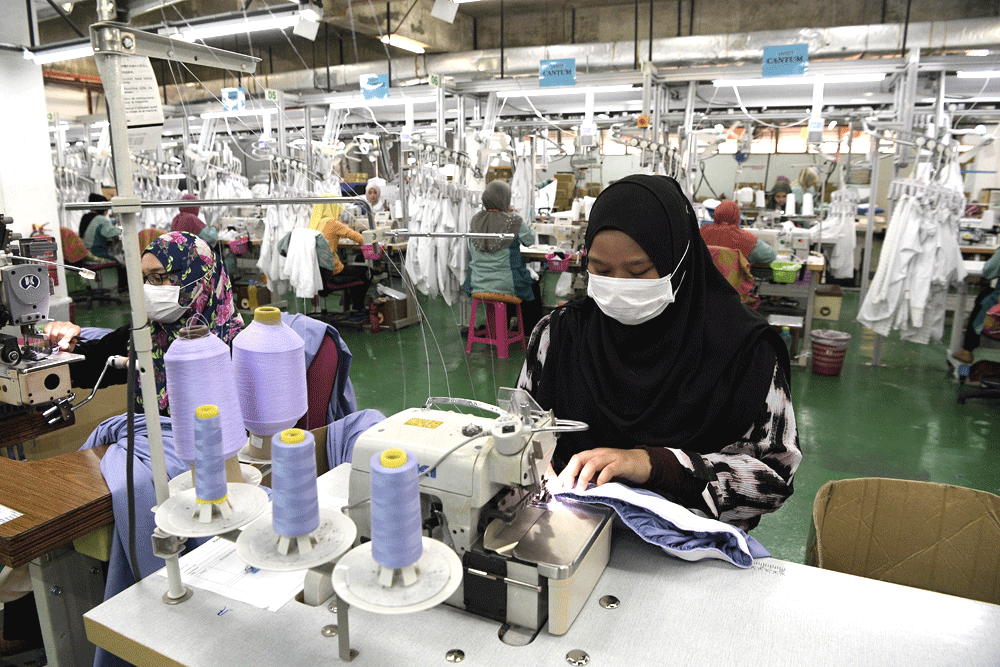
The federation said the manufacturing sector is already severely impacted by business closures of the non-essential sectors and the reduced capacity operations of essential sectors. — Bernama photo
KUCHING (July 2): The Federation of Malaysian Manufacturers (FMM) has urged the government to move into Phase 2 of the National Recovery Plan (NRP) to avert irreversible damage to the economy amid the Covid-19 pandemic.
Its president Tan Sri Datuk Soh Thian Lai said the manufacturing sector is already severely impacted by business closures of the non-essential sectors and the reduced capacity operations of the essential sectors.
“We have proposed that the government review the three thresholds of the NRP for a faster transition to Phase 2 and open up of more sectors to minimise the damage to businesses and the economy,” he said in a statement today.
At present, Phase 1 of the NRP has been extended indefinitely until the daily Covid-19 cases drop to below 4,000, the rate of intensive care unit (ICU) bed usage is at a moderate level, and 10 per cent of the population has completed vaccination.
Soh asserted that vaccination is key to economies moving back to normalisation, allowing restrictions to be relaxed and border curbs to be dismantled, minimising the need for lockdowns.
He said the government should not just focus on reducing cases but instead work on driving large-scale vaccination as this is the only way to return to pre-pandemic times.
The government should also implement state or area specific lockdowns targeted at the highest number of infections to contain the spread, he said.
He added states or areas where the cases are lower and under control should be allowed to operate without distinction between essential and non-essential sectors.
For targeted lockdowns, Soh said the government should do mass testing and expedite vaccination appointments for all concerned.
He opined companies should also be allowed a 10 per cent capacity in the targeted lockdown areas with approval from the authorities.
“The government should allow a parallel vaccination programme by private hospitals and clinics and for the National Pharmaceutical Regulatory Agency (NPRA) to accept WHO-approved vaccines without imposing additional requirements at the national level so that the private sector can purchase vaccines not used by the National Covid-19 Immunisation Programme and expedite the vaccination process for all.
“If the delivery of vaccines is a constraint, the current threshold of at least 10 per cent to be fully vaccinated should be reviewed to 10 per cent with at least one vaccine dose and setting a minimum threshold within each company so that companies can be allowed to operate and/or increase capacity.
“Companies that opt for private immunisation should be allowed to claim the cost from their HRD levy and be allowed for tax deduction where applicable,” he suggested.
Soh said FMM supports the need to fix a ceiling price for private immunisation depending on the cost of the vaccine to avoid any profiteering by the parties involved.
“While waiting for the immunisation to be completed, continue with mass testing of the general public including foreign workers, especially the undocumented ones, as mass testing has been proven to be a very effective approach to pick up positive cases and trigger the necessary tracing, isolation, and treatment protocols,” he proposed.
He also called for a comprehensive strategy for vaccination of undocumented foreign workers as they will pose a threat to the attainment of herd immunity if unvaccinated.
He added that the government must put in place a comprehensive strategy and action plans to address the likely shift of Covid-19 from pandemic to endemic, and how the population will have to live with it.