


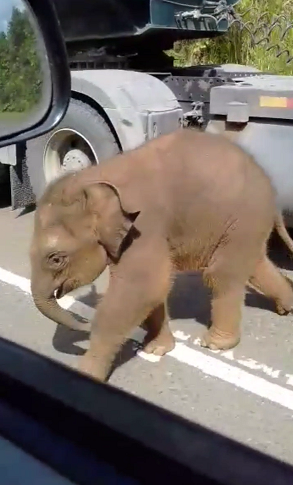
A baby elephant separated from mother due to main road traffic. Credit: Screenshot taken from a community member’s video in Telupid 2018
KOTA KINABALU: The Sabah government urgently needs to deliberate on alternative route options in the Telupid stretch of the Pan Borneo Highway (PBH) in order to create maximum positive impact for local communities while avoiding unnecessary environmental and ecological costs, especially for the endangered Bornean elephant.
Two new routes could deliver socio-economic benefits without major ecological and environmental impacts and serve as alternatives to the current proposed alignment and the initial alignment along the existing Ranau-Sandakan road that the government already rejected on the grounds of negative community impacts.
Sabah NGOs and research institutions associated with Coalition Humans Habitats Highways (Coalition 3H) want the Sabah Government to look at these alternative routes and select the best option in the interests of local communities and wildlife.
The current proposed alignment of the Telupid section of the four-lane highway runs through 30 kilometers of Bornean elephant range, including blocking their usual migration paths in the Class I Protected Tawai Forest Reserve, which would likely result in a stream of incidents harming both people and elephants, while generating public and global criticism. Additionally, this forest reserve lies on ultramafic soils making it vulnerable to major fires during droughts, with roads adding to fire risks.
In their report titled Optimal Routing Options for the Telupid Section of the Pan Borneo Highway, the coalition describes four options: Route 1 as the current proposed alignment which cuts through Tawai Forest Reserve; Route 2 as the initially planned route along the existing road that will significantly displace current villages; Route 3 is a new proposal that combines the current alignment to maintain the Telupid Town connection, with a northern bypass across the Labuk River to avoid key elephant areas and Tawai Forest Reserve; and Route 4 is also a second new proposal that runs entirely north of Labuk avoiding most known elephant range and protected areas.
The report summarizes the differences between various PBH alignment options across the Telupid region, comparing factors related to length, engineering challenges, potential cost considerations, local socio-economic impacts both positive and negative, and wildlife and environment impacts.
Land title information was also mapped to show impacts and the potential scale of land compensation requirements.
“Routes 3 and 4 by far emerged as the strongest options. In terms of the environment and ecological impacts, these two routes would help prevent negative impacts on the local elephant population, as well as other threatened species that live in Tawai Forest Reserve.
“Routes 3 and 4 would also help avoid forest fires, forest encroachment and other environmental risks that are associated with the PBH going through this Class I Protected Area. Avoiding Tawai Forest Reserve would also ensure the protection of the forest watershed, which is the main source of potable water for Telupid town,” Coalition 3H spokesperson Cynthia Ong said.
She added in terms of social impact, Route 4 avoids significant loss of land by resident indigenous communities, while routes 1 and 4 require least land acquisition and associated costs. Proposed bridges on routes 3 and 4 over Labuk River replace busy ferry crossings and with that deliver major development benefits for palm oil companies and communities isolated north of the river.
“The existing Route 2 and proposed Route 3 maintain Telupid town’s strategic function including as a transport stop over,” Cynthia said.
The report also suggests mitigation measures such as wildlife overpasses are very expensive and not always successful, and it would be better to spend any extra budget on a new route avoiding Tawai Forest Reserve so that costly mitigation measures are not needed.
“We recommend cancellation of routes 1 and 2 on grounds of environmental and socio-economic impact. We further recommend that the State Government discuss the importance of the PBH access to Telupid town and carry out engineering and cost studies on either Route 3 if connection with Telupid town is considered important and worth the likely extra expense, and Route 4 if this is not.
“We also recommend that a relevant government agency champions the formation of a joint committee dedicated to consolidating field data for enhancing infrastructure development planning in Sabah. Together with other stakeholders, Coalition 3H can contribute our ground knowledge effectively to the State Government through the joint committee,” Cynthia said.
She added that much success is being achieved in Telupid with managing the human elephant conflict through a collaboration between Sabah Wildlife Department, Sabah Forestry Department and Kopisuladan Di Aki (local Community Elephant Ranger Team or CERT), with support from Forever Sabah, Seratu Aatai, Hutan and Danau Girang Field Centre. However, if the four-lane PBH were to be built though Tawai Forest Reserve, effectively severing the northern portion of the reserve, it would have serious impacts on elephants and other wildlife populations.
Kopisuladan Di Aki and other conservationists are planning restoration efforts to increase the availability of elephant food-plants at Laju Cahaya, a former sawmill and log storage site and along the old logging road within Tawai. This can only be usefully undertaken if the highway is realigned.