


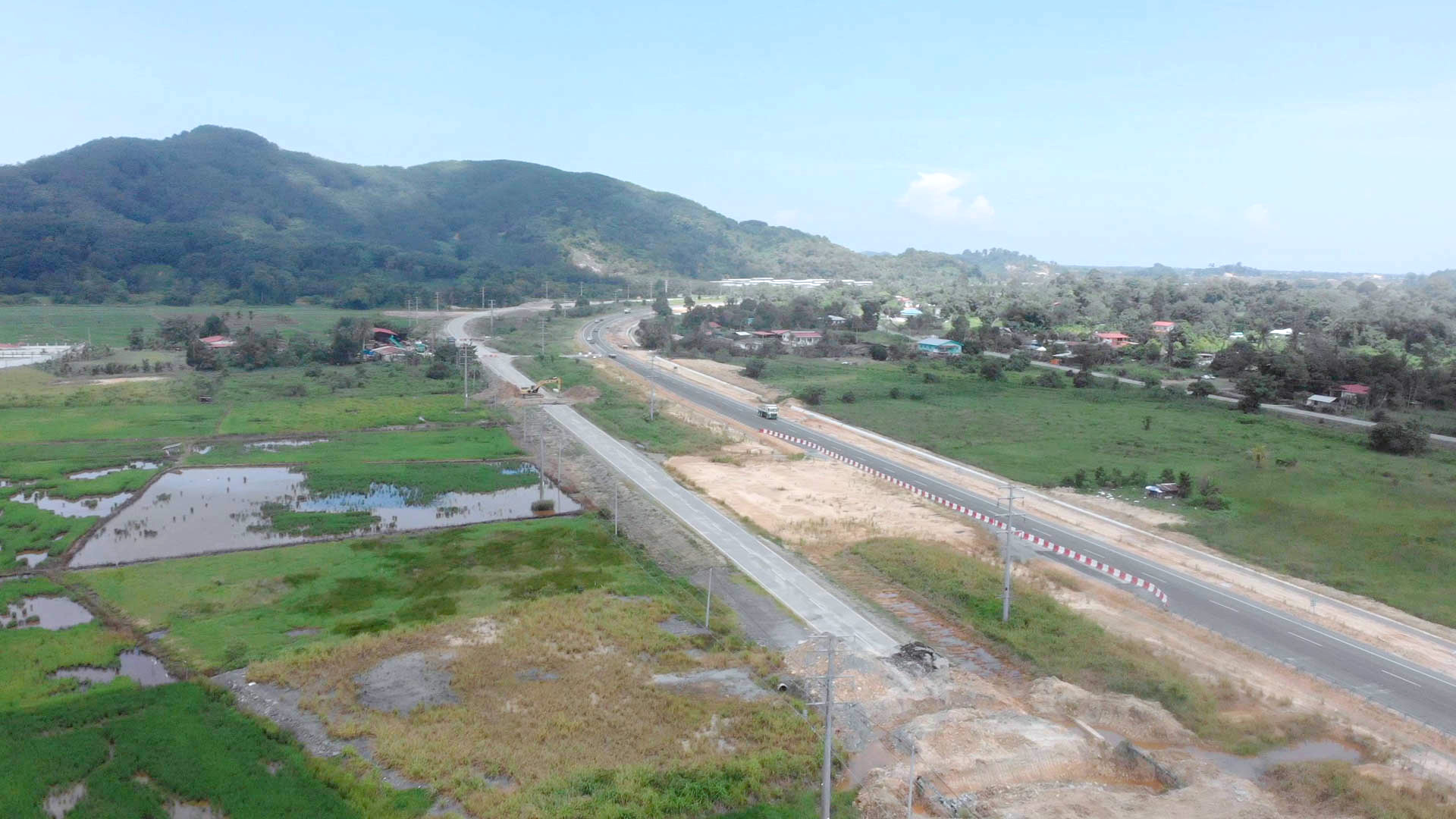
A highway built across a paddy field in Papar.-Photo by Forever Sabah
KOTA KINABALU: Food security is imperative, especially when the country is struggling with the Covid-19 pandemic. Prompted by this predicament, final-year students of University College Sabah Foundation (UCSF) visited some of Sabah’s largest “rice bowls” to explore risks that potentially compromise rice production.
The loss of prime paddy land to infrastructure and housing development has long been lamented in Sabah, as has been the disruption caused to irrigation and drainage when roads run across valleys.
But the students looked at a more hidden concern: whether roadwork has any impacts on the soil and water chemistry of the paddy fields themselves.
According to the Third Sabah Agricultural Policy (SAP3), the average self-sufficiency level (SSL) for rice in Sabah is currently only 32%, which is well below the target set by SAP2 of 60%.
Federal and state governments continue to make major investments in rice production in Sabah, with one of the state’s development challenges being how to grow the road network without losing the paddy field ecosystem.
Driven by these real-world issues and food security concerns, UCSF students investigated the paddy fields where Pan-Borneo Highway construction is ongoing in Papar and Kota Belud.
These renowned agricultural landscapes are now dissected by miles of linear heaped hill cuttings upon which the new road will be built. Such massive earthwork can be expected to introduce unwanted siltation in the canals and fields, while pollutants from roadwork chemicals and machinery could leach into the paddy lands. The risks may be spread through irrigation canals.
To assess roadwork impacts on soil and water quality, samples were extracted from the paddy fields to measure the usual variables for assessing safety and pollutants including pH, electrical conductivity, moisture content, organic matter, total nitrogen, bulk density and heavy metal contents such as cadmium, chromium, copper, lead, zinc, iron, magnesium and manganese.
Meanwhile, baselines were measured in the paddy fields of Tambunan which are unaffected by roadwork, so that the students can scientifically compare the levels of pollutants with and without road building.
Pollutants and toxic elements that build up in waters and soils may affect the healthy growth of paddy. Moreover, the metals may accumulate in the rice grains, and thus potentially be harmful to people when consumed.
High chromium levels were found in soil samples from Kota Belud when compared to soil samples of Papar and Tambunan. This may be caused by machinery traffic and steel used in the roadwork processes.
High levels of manganese and iron were also found in water samples from Kota Belud when compared to water samples of Papar and Tambunan. Studies have shown manganese can originate from vehicular engine combustion of methylcyclopentadienyl manganese tricarbonyl (MMT) and manganese toxicity can affect plant metabolic processes.
Further increase of heavy metals in the soil and water can be expected in the future when the highway is open to traffic. This is supported by studies in Malaysia, China and around the world that show heavy metal contamination from roadside soils to the adjacent agriculture sites can become more significant once the road is in heavy use by traffic.
As expected, road building did not impact dissolved oxygen, biochemical oxygen demand and chemical oxygen demand levels. These were found to be acceptable and within the Class 4 threshold for agriculture irrigation of the Malaysian Water Quality Standard.
Empirical data collected by the UCSF studies are expected to be valuable for informing the planners and roadwork contractors to deploy the necessary safeguards for protecting the critical “rice bowls” of Kota Belud and Papar. It also alerts us to risks to areas in Sabah where roads may be planned across paddy lands.
Ibrahem Wasti, Project Supervisor, University College Sabah Foundation, said, “The problems caused by chemical disturbances that affect our paddy fields from continued unsustainable development practices are two-pronged. First, they may significantly decrease the crop yield by inhibiting biological processes in the paddy themselves. Second, consumption of the affected paddy and chemical runoff into water sources may eventually lead to chronic health problems for people and the surrounding ecosystems if not dealt with correctly.”