


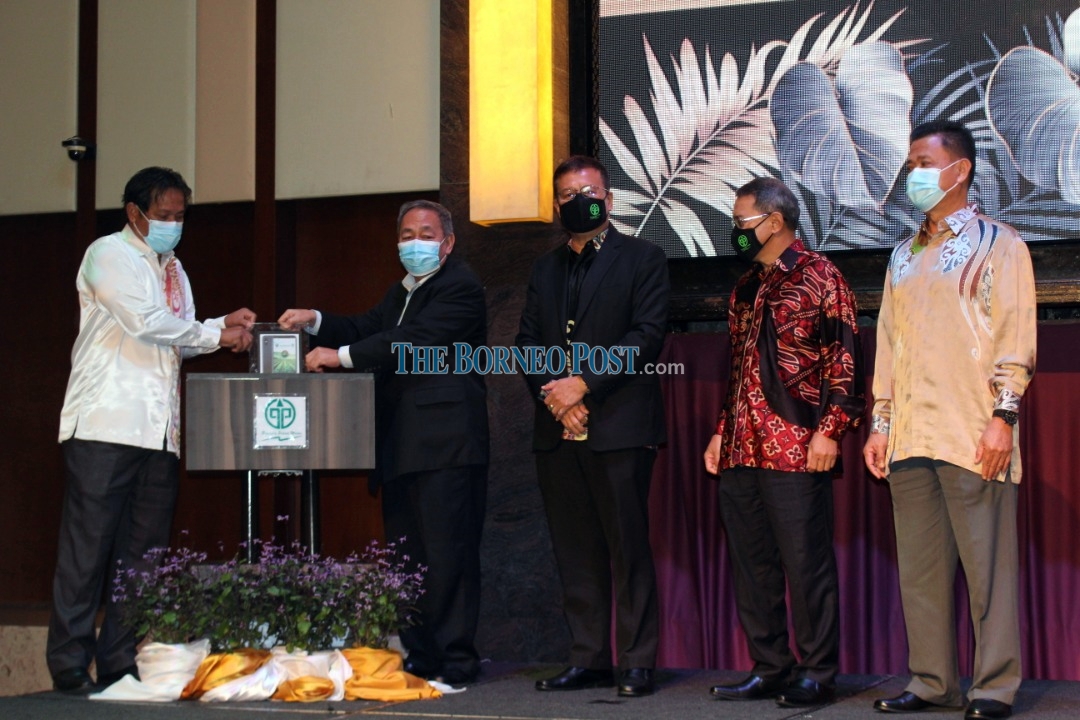

Abdul Rahman (from left) and Sagah launching the Wimics and ASID mobile applications during the ceremony, while Chai, Edwin and Aloysius look on.
KUCHING (Dec 21): Sarawak Agriculture Department has commenced with a large-scale MR269 paddy seed production programme starting in Sri Aman division to enhance food security and productivity, said its director Dr Alvin Chai.
Speaking at the department’s appreciation ceremony at a local hotel here today, Chai said the current local paddy seed varieties are less productive due to low yield, longer harvest period and can only be planted once per year, whereas modern variety is able to produce a higher yield of four to five metric tonnes per hectare.
“The justification behind this is also that we could not rely solely on the importation of paddy seeds from Peninsular Malaysia due to the imposition of ban on paddy seeds export,” he said, pointing out that the modern variety could be planted twice a year at three to four months harvesting period.
Once the harvesting has been completed this season, Chai said the department is expecting to have a total yield of 100 metric tonnes of MR269 paddy seed variety at Tanjung Bijat, Stumbin and Pantu.
With the advantages offered by the MR269 seed variety, he felt it was high time for the state to produce its own paddy seeds and the initiative in Sri Aman would be replicated in other areas.
He said these modern variety of seeds will be distributed to smallholder farmers in various areas such as Tanjung Purun in Kuching Division and Skuduk-Chupak in Serian.
Chai stressed modern paddy seed varieties would play a critical role for the state to achieve paddy self-sufficiency level of 70 per cent by the year 2030 and another variety, MR297, as recommended by Malaysian Agricultural Research and Development Institute, was also introduced to smallholder farmers.
Moreover, between the year 2019 and 2020, he said the department had procured machines for paddy planting for the southern region in Kuching, Serian, Sri Aman and Betong, due to lack of machinery.
He pointed out the among the machines procured included 24 units of paddy combine harvesters, nine units of tractors and eight units of transplanters.
Furthermore, Chai said the department had conducted a research on the production of compost from the excess of durian husk and banana stems to overcome the issue of waste arising from the excess.
“These composts have been successfully trialled on vegetables at our Agriculture Research Centre, and it is proven that it is comparable or even better than the chemical fertilisers.”
Moving forward, Chai said the department planned to formulate the composts for a large-scale production by engaging with Areas Farmers’ Associations on the business venture.
Meanwhile, Deputy Chief Minister Datuk Amar Douglas Uggah Embas said the state government had come up with various initiatives, such as the setting up of more Collection, Processing and Packaging Centres (CPPCs) and food terminals to support the commercialisation of the farming industry.
“This Covid-19 period has alerted the department on the urgency to develop our own seeds in order to support our food industry and to be less dependent on importation of food products.
“The seeds, planting materials, fries and broodstock are the foundation of self-sufficiency on rice and other food products, thus this area has to be looked into first before we can talk about commercialisation,” he said.
Douglas’ text-of-speech was read out by Assistant Ministers of Agriculture Native Land and Regional Development Datuk Roland Sagah Wee Inn at the appreciation ceremony.
The deputy chief minister added the changes introduced into the department were very much welcomed as it would drive the agriculture sector towards the state aspirations of becoming a net agrofood exporter by the year 2030.
In terms of agro-food trade, he said the state experienced a deficit of RM3.98 billion last year, while the agriculture sector as a whole had contributed to about 12.1. per cent or RM16.5 billion to the state’s gross domestic product (GDP).
“This figure shows that there is a lot of catching up that we need to do in order to achieve our goal, but after hearing the speech from the director earlier, I am confident that we will be able to reduce the food trade deficit and subsequently, turn that deficit into a surplus.”
Uggah also advised the department to form a special team to filter and scrutinise all information to be disseminated through social media for better content security, management and handling.
The event also saw the launching of Weed, Insects, Microorganism Collection Sarawak (Wimics) and Agrosoils Soil Information Delivery (ASID) mobile applications for better planning on agriculture development matters.
Among those in attendance was Assistant Minister of Agriculture Native Land and Regional Development Datuk Dr Abdul Rahman Ismail, the ministry permanent secretary Edwin Abit and the department’s deputy director (operation) Gavin Aloysius Dom.
The post Chai: Dept starts MR269 paddy seed production programme to enhance food security, productivity appeared first on Borneo Post Online.