


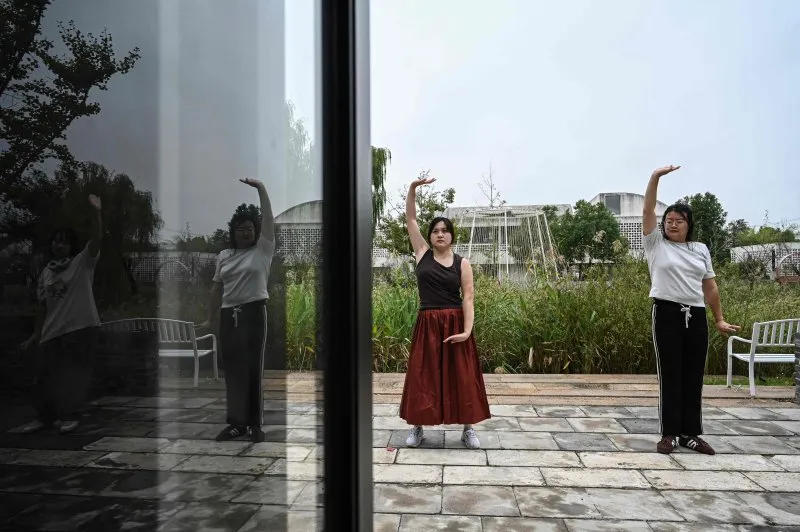
Digital nomads practise Tai Chi at the Digital Nomad International Village in Caojing on the outskirts of Shanghai, China on October 19, 2026. — AFP pic
Stay updated on the latest news and insights. Subscribe to our newsletter here


SHANGHAI, Nov 30 — In a sleek library next to wheat fields in Shanghai’s farming suburbs, a dozen millennials work busily on laptops, many using AI, giving a welcome boost to this village of mostly retirees.
China’s local authorities are rebranding sparsely populated localities as artificial intelligence talent hubs, offering quieter lives to mid-career tech workers seeking refuge from urban pressures.
In April, the town of Caojing – in an idyllic nature reserve roughly 60 kilometres (40 miles) south of central Shanghai – joined a list of places across China promising millions of yuan in subsidies for small-scale AI ventures.
Eligible start-ups who move there get free access to a shared office space, grants of up to 10,000 yuan (RM6,100; US$1,500) and one month of free housing, the town has said.
Such hotspots are one outcome of Beijing’s “AI Plus” policy blueprint, to incorporate the technology at virtually every level of learning and life.
“AI is devouring everything,” said 38-year-old Wind Liu, who moved with his wife to Caojing’s Shuiku village three months earlier.
They and around 30 other residents live in a few dorms converted from houses, in a digital nomad outpost billed as a community for AI-driven firms.
Liu, an English teacher, uses the Chinese AI video generation tool Seedance to produce animated vocabulary lessons featuring characters from American TV shows he posts on social media.
“I need to be online… I need to get clients. I definitely need to have a relationship with technology,” said Liu, wearing a “Think Less ChatGPT More” T-shirt.
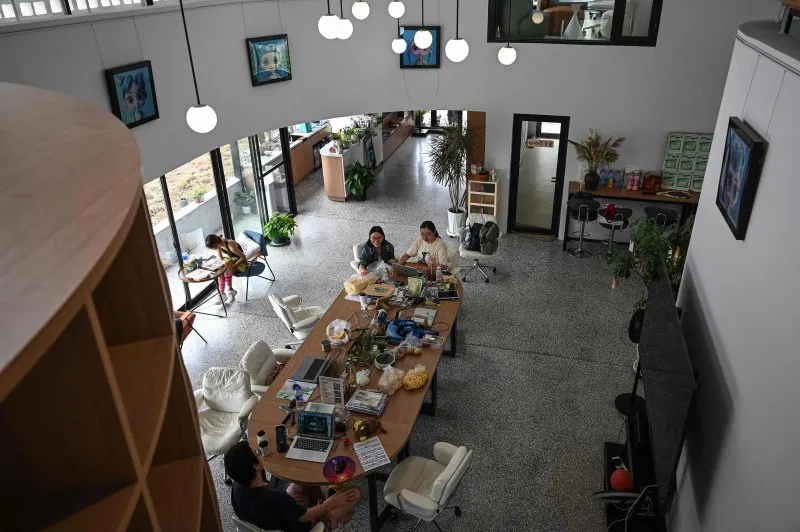
Digital nomads work in the library of the Digital Nomad International Village in Caojing on the outskirts of Shanghai, China on October 19, 2026. — AFP pic
The village also offers him a respite from the non-stop “996” lifestyle in Chinese megacities – a phrase describing 12 hour work shifts, six days a week.
“Most people I’ve met here hope to get more freedom, with space, with time,” he said.
On a recent Monday, five roughly 30-somethings started the morning with a half-hour of Tai Chi in a light drizzle before splitting off to work.
“The people who come to us are a bit more mature,” said the community’s project head Baicao Li, as a kitten waltzed between her feet.
She works for a Beijing-based company that partnered with the local government in 2024 to build the digital nomad base in the village.
“They want to subtract from their life,” added the 34-year-old.
“They hope to, in an era defined by an information explosion, maintain a greater degree of focus,” she said.
No ‘lying flat’
Those who shun the rat race in China – dubbed “laying flat” – can walk a tricky line.
In April, Beijing’s Ministry of State Security linked the phenomenon with “anti-China forces”.But local authorities are marketing their sleepy towns as hubs for innovation, not idleness.
“A hope is that these people will… build some of their own startups or companies, and maybe one day it will kind of boost the local economy,” said Zilan Qian, a researcher on China’s AI development at the think tank GovAI.
Those drawn to village tech hubs are not “laying flat”, Qian added.
“People are just anti the kind of ‘996’ and the traditional very crowded and very fast-paced working style, but (it) doesn’t mean they don’t want to work,” she said.
Liu, the English teacher, believes that AI could eliminate 90 per cent of jobs by as soon as 2030.
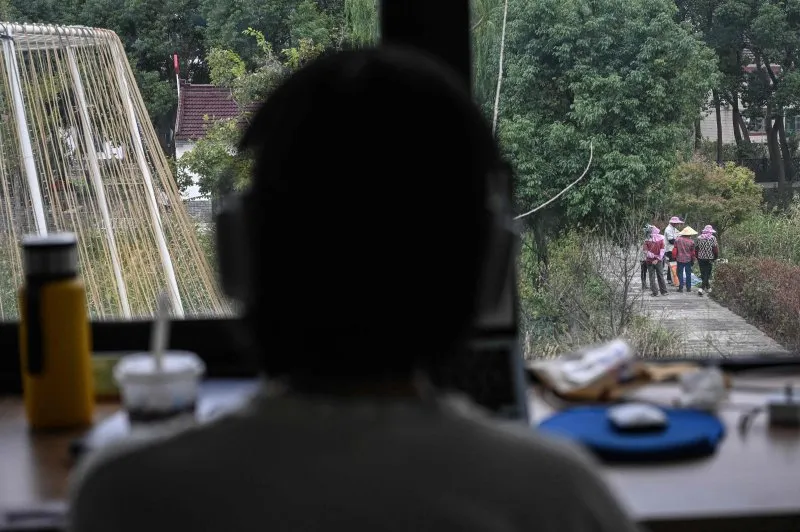
A digital nomad works on a laptop as villagers walk along a path at the Digital Nomad International Village in Caojing on the outskirts of Shanghai on October 19, 2026. — AFP pic
For his videos, AI tools now handle scriptwriting, recording and editing tasks that previously needed multiple people, he said.
But he isn’t anxious.
“Chinese people have a relatively strong ability and high willingness to accept new things,” he said.
The nomads’ arrival has boosted the local economy, said one woman with silver-streaked hair who declined to give her name, pulling weeds outside the library.
“There are more people here now. There used to be fewer, and next there will be more and more,” said the woman, who lives in a nearby village.
But actual interactions are limited.
Across the street from one nomad dormitory, a woman in her 80s sorting dried beans said her young neighbours were polite but that there was a fast turnover.
The community hosts events for village retirees, but she attended only a couple when they first arrived, she said. — AFP