


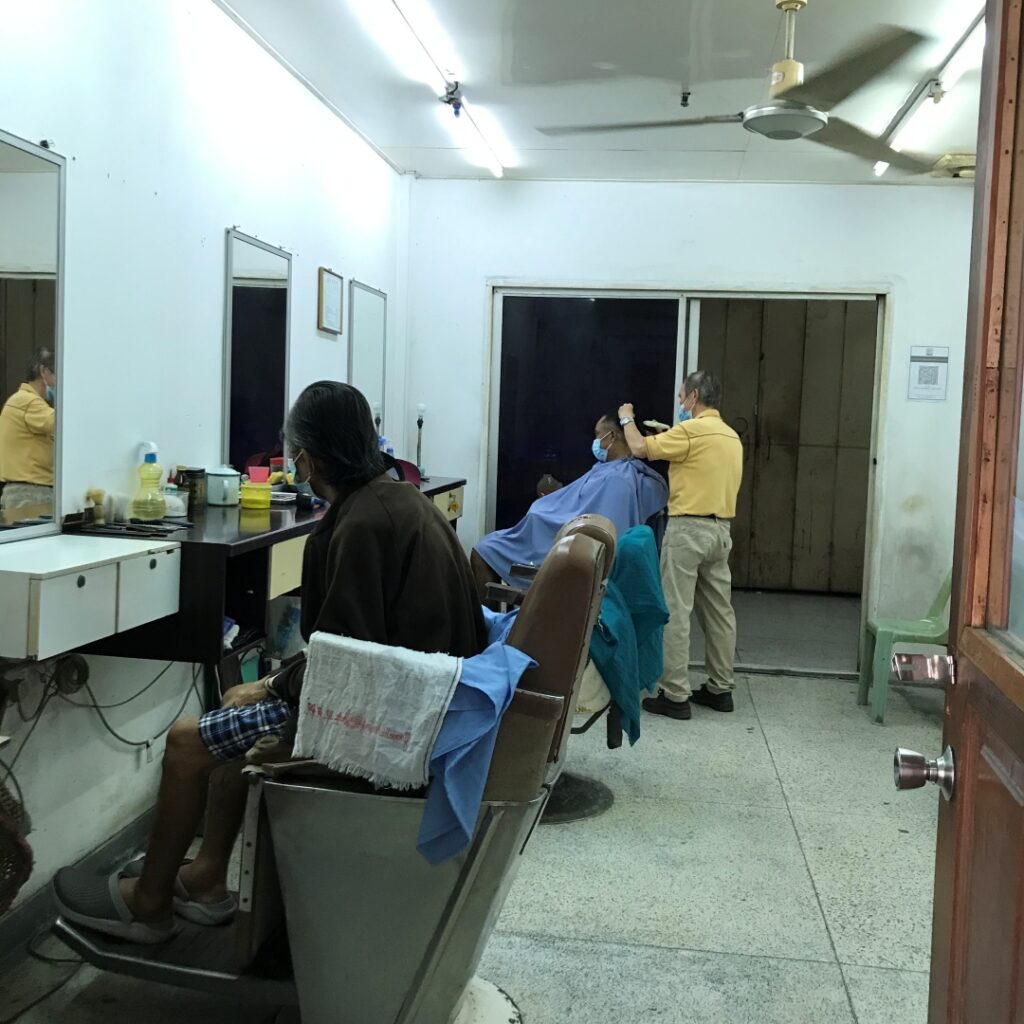
An elderly barber cuts a customer’s hair at a shop in Park Arcade, Miri. He has been running his business there for more than 40 years.
Every operator relates his own experience, challenges in running the business and sustaining it during this pandemic period
MANY men have no choice but keep their hair long throughout the various phases of the Movement Control Order (MCO).
For offshore personnel Richard Coussal, he had been keeping his hair longer than he usually would as during the past MCO period, the barbers in Miri were not allowed to open for business.
“Many of my friends depend on their ‘home barber’ – meaning, their wives – to cut their hair.
“Others would ask their relatives to do it secretly in their backyards,” he told thesundaypost.
He acknowledged that it had been ‘a strange year’ for him and most Mirians.
“I’m sure that many miss hair-grooming at the salons.
“After a long wait of three months, I finally got my haircut once the hair salons were allowed to open – just in time for me to go back offshore for work,” he said.
Richard’s mother, Jennie Chang, a retired teacher, was just relieved to see him finally able to sport a smart, cropped look after having had long, messy hair over the past several months.
The ‘Andy Lau’ salon
This life-size cut-out of Andy Lau would ‘greet’ every customer coming to Wong’s barber shop.
The operator of ‘One Man Barber’, known to his customers as ‘Mr Wong’, has been calling Miri his home for almost three decades.
Hailing from Ipoh, Perak, he married a Sibu Cantonese woman and together, they set up their salon business in Brunei in the 1970s.
In the 1990s, Wong and his family moved back to Miri so that their children could enjoy Malaysian education and have what he described as ‘the opportunity to land good, permanent jobs’.
His wife had a dressmaking background, so he regarded both of them as ‘using scissors to make a living’.
“We’re living the dream of many Chinese migrants – ‘have knife will travel’,” said Wong, referring the term ‘knife’ to his sharp trading tools such as scissors, clippers and trimmers.
The septuagenarian is very popular amongst many Mirians, but when it comes to his shop near the old Miri Fish Market at Jalan Bendehara, they rarely call it by its registered name.
“The people here call me ‘Andy Lau Barber’ because I have a life-size cut-out of the Hong Kong artiste, whom I really admire, to attract customers.
“The registered name of my salon, in Mandarin, is ‘Tang Ren Jie’, or ‘Chinatown Barber’.
“Back to ‘Andy Lau’ – if you told a taxi driver to find ‘Andy Lau Barber’ in Miri, he would take you to me! I’m operating along at alley in the back, but the Andy Lau’s cut-out is big enough, you can surely spot my shop!” he laughed.
Wong: Those who know me, call me ‘Andy Lau Barber’.
Wong had enjoyed fairly good business until the Covid-19 pandemic was declared early last year.
Since then, his income has been cut to half.
“I’m glad to have been able to provide education to our children when the income was fairly good. Now, it would be impossible to survive.
“My salon had to be closed for a long time, beginning March 2020.”
Wong said his shop had a display corner where he would arrange items like shoes and accessories, baskets and other trinkets for sale – all these occupying his small premises covering a space of not more than 225 square feet!
“I had to make a living. Selling some goods could help me earn a bit extra. In between, I’d read my newspapers and listen to the radio.
“That said, my life in Miri has been good. People don’t treat me as an outsider, so I’m very happy here.”
Wong is a happy barber who does not mind sharing with other lots of stories about everything.
It is a therapeutic session for anyone getting a haircut from him – one can chat with Wong about any topic under the sun.
‘An alley with no name’
There is an alley in Miri, which does not have a name, but is famous for housing old-school barbershops.
One of them seems to have been around for decades, judging by its elderly customers – some of whom have been patrons for more than 20 years.
This shop has been quite famous for such a long time, but people just cannot remember who started the business. The unit is located behind the Chinese Chamber of Commerce headquarters in the city.
“It’s an old man’s habit – going to the usual barber,” said Sigoru Lasor, a staff member of Gymkhana Club Miri.
“I have been going to the same barber for more than 25 years, getting the same neat haircut.
“I just trust him. In saying so, I’m so glad that after three months of MCO, I get to see him again and he’s so happy to see me – we’re really old friends, having seen each other from the days when our hair was still black, to now when we both have white hair.
“Now, my head feels ‘lighter’ after having my haircut. Having long, unkempt hair has been most uncomfortable.”
Sigoru shows off his fresh haircut.
Zalfudhili Abdullah, also a Gymkhana employee, was also happy to be sporting short hair again.
Just like Sigoru, he went to his favourite old-time barber, instead of going to one of those trendy salons where he would have to pay 10 times more.
The barbers operating along this alley accommodate children and students as well, offering them special discounts for haircuts.
Every so often, one could see grandfathers bringing their grandsons to get haircut there.
Zalfudhili says he immediately got his haircut after the relaxation of the MCO in July.
Some of the barbers have been operating for over 40 years. A few are Heng Hua clansmen who had migrated from Sibu during the 1960s.
Most of the barber shops have four hairdressing chairs, while some have only two.
It is accepted that on busy days, customers have to wait for their turns outside the shops. In this regard, every operator would provide wooden chairs outside for them to sit while waiting.
Now, in compliance with the social distancing requirement under the Covid-19 standard operating procedures (SOP), the operators must make sure that the chairs – the ones inside the shop and also the wooden ones outside – be arranged to be at least 1m apart from one another.
This is the new norm going forward.
Entrepreneurial spirit
Mohammad Arif Ong, a youth in his early 20s, has just graduated from GiatMara Miri and is now operating a modern barbershop at Emart Riam.
His ‘Da.Di.Du Borneo Haircut’ lot is equipped with three hairdressing chairs, but like other barbershops, he also provides plastic chairs outside for the customers to wait during busy days.
Having done his apprenticeship in Kuching, Arif said he was happy to be earning ‘a good enough income’.
“In all honesty, I was just not interested in studying. I completed Form 3 and left school.
“About a year after that, however, I joined GiatMara and learned hairdressing.
“I’ve been quite happy since,” he smiled.
The Da.Di.Du Borneo Haircut lot at Emart Riam, managed by Arif.
Arif’s shop signifies what many businessmen view as a key contributing factor to running a good business – location.
“Husbands who accompany their wives during a shopping trip can stop by at my shop and get a haircut, which is a pleasant way of waiting for their spouses.”
However, like other trades, his operation has been adversely affected by Covid-19.
“Yes, business is slow. We must all wear face masks and wash our hands regularly.
“Daily disinfection is a must, and we maintain cleanliness at all times.
“We also don’t use air-conditioning in our small space here.”
Da.Di.Du Borneo Haircut does look very clean and airy, and despite it still sticking to ‘old-school barbering’, it also provides other more contemporary services such as hair-tattooing, facial-hair sculpting and ‘skin fade’ – lending it an ambience that radiates a ‘young, trendy and vibrant feel’.
Arif said hopefully, by words of mouth, his business would attract more customers going forward.
‘Park Arcade’
The Park Arcade in Miri is like a place frozen in time.
It is a reminder of a time when Mirians could enjoy having Sunday coffee and set lunches at the Park Hotel in the 1990s – for only RM10 per person.
Being one of the oldest business addresses in Miri, Park Arcade was once the ‘go-to place’ in Miri for the business folk to negotiate and close major deals. The timber merchants would come and stay at the Park Hotel, purchase their flight tickets from the travel agency and enjoy their coffees and snacks at the coffee-house.
In the evening, the Amigo Nightclub would host these businessmen, who would then reciprocate by spending thousands of ringgit on food and drinks, while enjoying the performances delivered by the Taiwanese singers.
The elderly barbers have plenty of stories to share with their customers, who would be seated on the worn-out old-fashioned hairdressing chairs.
In every barber shop, the air ‘smells of nostalgia’.
“We had good business – all honest and healthy operations.
“We provided good service, one that had helped us raise and provide for our families.
“Life went on well – until Covid-19 came and killed the people around us. It’s so sad,” said a barber who only wanted to be identified as ‘Uncle Tan’.
“If the government ordered us to close shop, we’d close shop; if they allowed us to open, then we’d open.
“We just have to be careful. Many of us are already into our 70s – we’re taking it slow, but we need to earn a living while we still can. We still have to pay our rents and our food.
“This is life.”
In reminiscing the past, Uncle Tan said many Chinese barbers came to Miri in the 1950s where later on, they would provide house-to-house haircut service.
“That was the trend in ‘Old Miri’. After having saved enough money, they would rent a place for their business.”
Uncle Tan acknowledged that nowadays, there are different classes of barbers.
“Today, there are hairdressers who charge their clients 10 times what we charge ours, and there are still many barbers here who go around on bicycles or motorbikes and charge RM5 per haircut.
“We, the traditional barbers, don’t want our customers to come in and feel that they cannot pay. Also, we put up the price list in front of the shop, which is good. Should any customer find our pricing as being too high, they could proceed to other shops,” said Uncle Tan.
In concluding this feature, the writer wishes to share an anecdote about her late father, who had always sported the short-cropped look as far back as his student days in Beijing.
He used to quote English author, humourist and scriptwriter PG Wodehouse, who had said: “Why don’t you get a haircut? You look like a chrysanthemum.”