


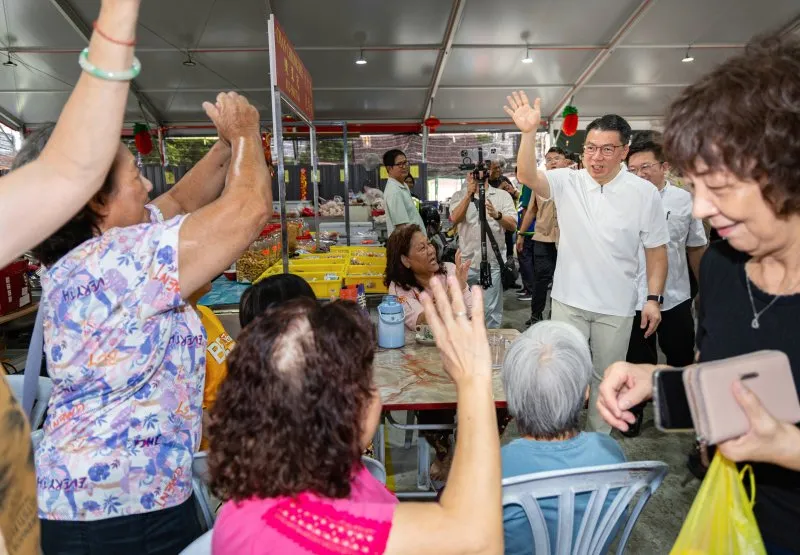
Housing and Local Government Minister Nga Kor Ming mingles with traders after presenting prizes for the design concept competition for the proposed construction of the Pasir Puteh Market at Taman Pasir Pinji in Ipoh November 29, 2026. — Bernama pic
Stay updated on the latest news and insights. Subscribe to our newsletter here


First Published: Sunday, 29 Nov 2026 4:42 PM MYT
Last Modified: Sunday, 29 Nov 2026 4:48 PM MYT
IPOH, Nov 29 — The Ministry of Housing and Local Government (KPKT) has allocated over RM200 million for the reconstruction and upgrading of public markets nationwide during the four-year administration of the Madani Government.
Its Minister, Nga Kor Ming, saId the allocation is distributed in a targeted manner based on specific needs and market categories to ensure these public facilities are comfortable and safe for both traders and visitors, with the potential to even become new tourism landmarks.
According to him, KPKT has also approved an additional allocation of RM60 million for the coming year, comprising RM30 million specifically for upgrading public markets and another RM30 million for the upgrading of food courts across the country.
“In total, KPKT has successfully implemented over 16,000 public infrastructure projects nationwide including the construction and upgrading of markets, food courts, ‘Clean, Charming, and Fragrant’ (BMW) standard restrooms, Madani Parks, drainage systems, and the installation of solar-powered streetlights marking the highest record in history,” he told reporters today, following the prize-giving ceremony for the design concept competition for the proposed construction of the Pasir Puteh market.
Elaborating further, he said several reconstruction and upgrading projects for public markets have incurred costs amounting to tens of millions of ringgit inclusing RM15 million for the transformation of the Ipoh Central Market (Pasar Besar Ipoh), RM12 million for the reconstruction of the Pinji Market, and a recent allocation of RM9 million to redevelop the Pasir Puteh Market, which was destroyed by a fire in February 2024.
“Furthermore, the Ministry of Housing and Local Government (KPKT) has successfully upgraded all eight public markets in the Taiping parliamentary constituency including the Taiping Central Market, which dates back to 1873 and has also reconstructed the Beruas and Ayer Tawar markets in the Manjung area,” he said.
Meanwhile, as part of efforts to transform the image of traditional markets, Nga noted that the ministry aims to develop at least one high-potential market in every state capital to serve as a tourist attraction, drawing inspiration from the success of the Central Market in the national capital and Pasar Payang in Kuala Terengganu.
“The Ipoh Central Market, which is currently undergoing a transformation, is expected to attract not only tourists but also the younger generation. This will be achieved through the hosting of art and handicraft exhibitions, as well as by serving as a hub for ‘Perak Batik’, an initiative recently launched,” he said.
He added that, as an administrative reform, all new large-scale market construction projects nationwide exceeding RM10 million must now undergo an architectural design competition. This ensures that elements of sustainability, comfort, and livability are effectively incorporated.
For instance, the new two-story design for the Pasir Puteh Market will feature a solar-based renewable energy system to power air-conditioned meeting rooms and community activity spaces on the upper floor, alongside a rainwater harvesting system to be used for cleaning the market floors.
Meanwhile, Kuee Architecture Sdn. Bhd. has been named the winner of the design concept competition for the proposed construction of the Pasir Puteh Market, marking a new chapter in the redevelopment of this traditional market, which is nearly 70 years old.
The competition, held from March to June, received 11 entries from professional architects. Three finalists were subsequently selected to present their respective design proposals on June 4.
The competition established design criteria that prioritise pedestrian accessibility, environmental sustainability, and energy efficiency, ensuring that the new market is modern, user-friendly, and capable of attracting a larger number of visitors. — Bernama