


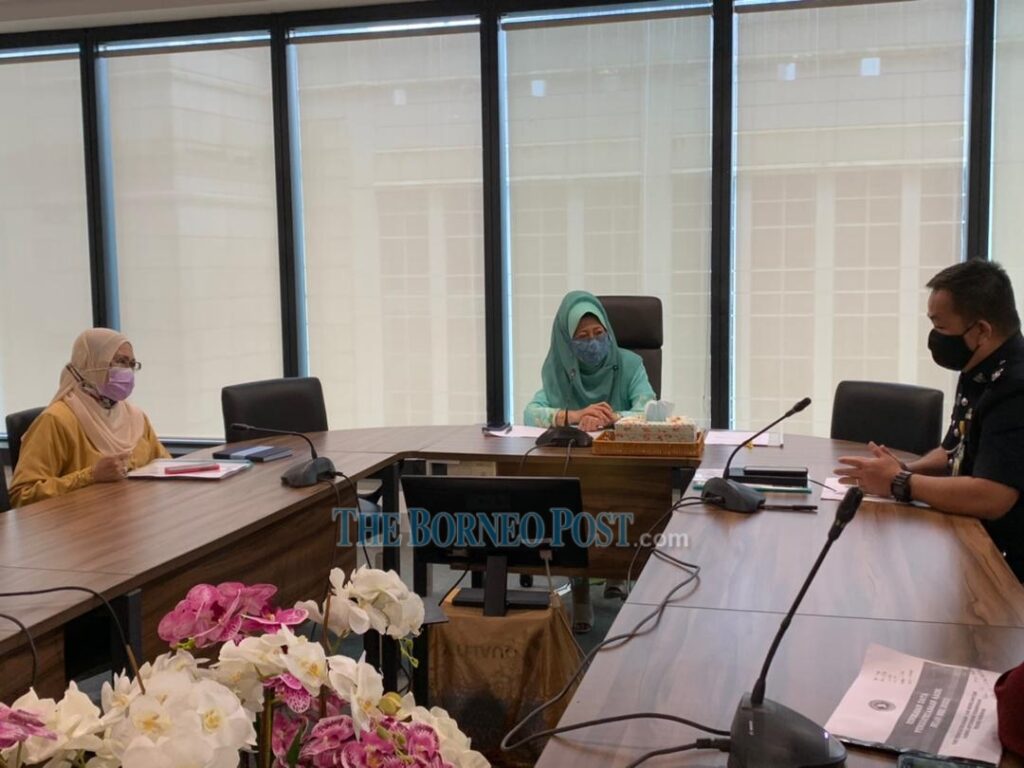
From left – Rashidah, Fatimah and Wong at the press conference.
KUCHING (June 18): The Covid-19 Movement Control Order (MCO) since January may have helped reduce drugs and substance possession and supply in the state.
Saying she did not have this month’s statistics to confidently announce this, Welfare, Community Wellbeing, Women, Family and Childhood Development Minister attributed the decreased number to movement restrictions.
“Based on evidence, we do see a decrease. To be able to say confidently there’s a declining trend, we need to wait further for June’s statistics.
“The MCO started in January and the full MCO started end of last month, so we need to wait until month-end,” she said at a press conference on the One Stop Committee’s (OSC) monthly report on addressing drug and substance abuse at her office in Bangunan Baitulmakmur (Masja), Petra Jaya yesterday.
Drug and substance abuse arrest statistics.
Giving a breakdown, she said 292 arrests were made from January to May this year for drug and substance supply and 843 arrests for drug possession during the same period.
Earlier, Fatimah said 540 enforcement operations were carried out by the Narcotics Crime Investigation Department (NCID) Sarawak, National Anti-Drug Agency (AADK) and Customs Department in May this year.
From the operations, 607 arrests were made – 42 for distribution, 155 for possession of drugs and substance, and 410 individuals tested positive for drug.
The figures showed a decrease of 16.5 per cent compared to 727 arrests made in April, she said.
“Through the operations, a total of 24.8kg of drugs and substance in compact form, and 28 pills were seized by NCID and Customs, with total value of RM282,706.18.”
In order to stop drug and substance abuse, she said her ministry focused on intervention actions in the form of treatment and rehabilitation.
“Even though we are in the Covid-19 pandemic, the OSC continues to address the issue of drugs and substances in accordance with the set standard operating procedures from time to time.
“As a result of integrated collaboration among enforcement and non-enforcement agencies in Sarawak, we are more effective in combating drug and substance abuse,” she said.
On the recovery rate of drug abuse in Sarawak, Fatimah said the ratio was now 1:8, which means out of nine people receiving treatment and rehabilitation, only one continued while the rest dropped out.
Elaborating, Fatimah said one of the ministry’s action plans this year is to increase access to treatment and rehabilitation in communities in high-risk districts by expanding the One Stop Centre for Addiction at health clinics in Lawas, Limbang, Subis, Betong, Bau, Bintulu and Sibu.
Secondly, there was also a plan to set up the Community Development and Intervention Centre (CDIC) to serve as a community caring house, with the pilot project being implemented in Bau by OSC Bau District.
“The ministry also places emphasis on preventive action through evidenced-based awareness, advocacy and screening programmes in educational institutions, the workplace, in the community and the family.
“As of May this year, a total of 63 series of prevention and prevention education programmes have been implemented by the district OSCs in the workplace, educational institutions and the community,” she explained.
During the press conference, Fatimah also shared the Mapping Based on Arrests Related to Drug and Substance Abuse Activities by District since January, which showed a total of 3,616 arrests were made, with Kuching recording the most with 1,003 arrests, followed by Bintulu (329), Samarahan (292), Sibu (269) and Miri (266).
Present were the ministry’s permanent secretary Dr Rashidah Bolhassan, NCID Sarawak deputy head Supt Wong Leong Meng and AADK Sarawak director Iskandar Turkee.