


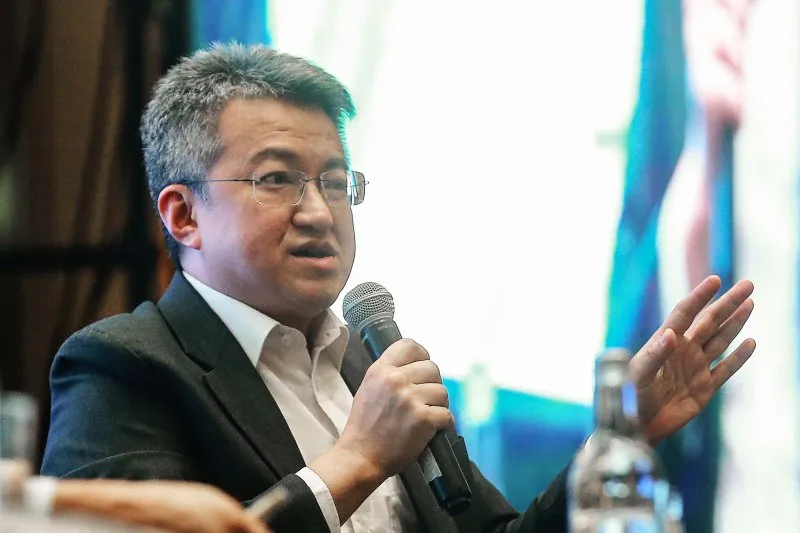
Deputy Finance Minister Liew Chin Tong said stronger domestic and regional consumer demand is crucial to sustaining economic growth. — Picture by Sayuti Zainudin
Stay updated on the latest news and insights. Subscribe to our newsletter here


By Soo Wern Jun
First Published: Thursday, 26 Nov 2026 11:59 AM MYT
Last Modified: Thursday, 26 Nov 2026 12:03 PM MYT
KUALA LUMPUR, Nov 26 — Malaysia and other Asean countries must build stronger middle-class populations with greater purchasing power to reduce their dependence on the United States as a consumer market, Deputy Finance Minister Liew Chin Tong said.
He said higher wages and developing companies capable of scaling up would be crucial to sustaining economic growth as global production capacity continued to expand.
“We cannot forever depend on the US as the consumer of the last resort,” he told reporters after delivering his opening address at the Malaysian Institute of Economic Research’s (MIER) National Economic Outlook Conference 2026 today.
“When our people are richer, then we are not dependent on one market. Not just in Malaysia but in Asean as well.
“More Malaysians becoming middle class, more Malaysians getting paid better, more Malaysian companies become mid-size companies with capability and ability to scale.”
Liew’s remarks came a day after the US proposed tariffs of up to 18 per cent on Malaysian goods under Section 301 of its Trade Act, citing concerns over industrial policies and excess manufacturing capacity.
Liew also said Malaysia should move beyond being primarily a trading nation and develop greater ownership of technology rather than simply trading goods and services.
“We do not have to be the top tech. We do not have to compete at the top level.”
Instead, Malaysia should establish itself as an indispensable middle player in the global technology supply chain, particularly as companies diversify production away from China, he said.
“Malaysia, Singapore and Vietnam together constitute a very important middle in semiconductor,” he said.
Liew also proposed closer links between the defence and semiconductor industries, stressing the need for practical innovation.
“I was deputy defence minister, and I used to openly say that the defence industry had too many traders and not enough innovators,” he said.
He also called for financial institutions to develop a better understanding of technology businesses.
“Every banker knows how to do financing for development, for housing development, but it’s time for us to have more bankers who understand how to finance and how to assess risk in the technology sector,” he said.
Liew noted that although the electrical and electronics sector accounted for about 40 per cent of Malaysia’s exports, technology stocks remained underrepresented on Bursa Malaysia.
He said Malaysia needed more mid-sized companies with the capacity to develop their own technology and scale up their operations.