


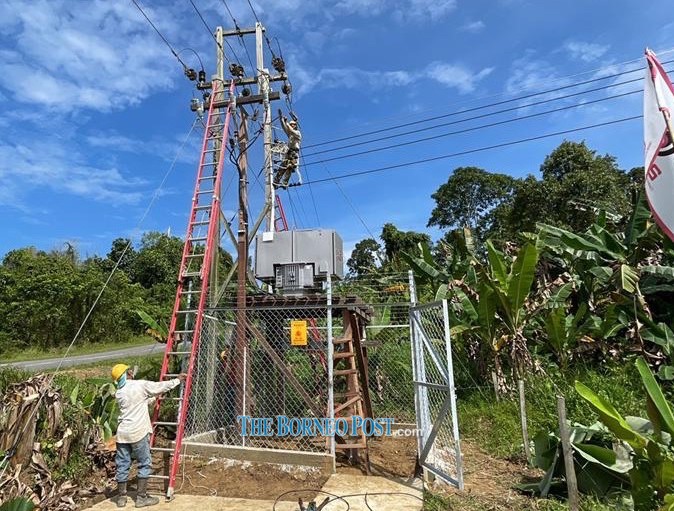
Photo shows the extension of the grid system for rural households with road accessibility.
KUCHING (June 29): Rural electrification coverage in Sarawak is expected to reach 97 per cent in the coming months, said Utilities Minister Dato Sri Dr Stephen Rundi Utom.
He said last year, rural electrification coverage stood at 95 per cent.
In a statement issued by Sarawak Energy Berhad (SEB), Dr Rundi said about 45 per cent of Sarawakians live in longhouses, kampungs, or smaller towns in rural areas.
He pointed out Sarawak has really stepped up its electrification efforts under the Projek Rakyat initiative to accelerate the Rural Electrification Master Plan 2018.
“We are thankful to the Sarawak government and YAB Chief Minister that our plan has been supported with an allocation of RM2.37 billion to cover rural transmission and distribution projects as well the implementation of the Sarawak Alternative Rural Electrification Scheme (Sares) in distant villages.
“I would like to express my thanks to the rural electrification team, including contractors and subcontractors, as well as all our partner agencies such as Resident’s and District offices as well as JKR (Public Works Department) for their hard work,” he said.
Dr Rundi said another big factor is the leadership provided by community leaders and the support of the rural folk, who look forward to the basic utilities their counterparts in town enjoy.
“I look forward to the day when we can confidently say there is no Sarawakian that is left in the dark,” he added.
The SEB statement also highlighted various projects implemented in rural northern Sarawak, including the mountainous Limbang Division, to ensure access to reliable and affordable electricity supply for the whole of Sarawak by 2025.
According to the statement, the Sarawak government, through the Ministry of Utilities and SEB as the implementing agency, is accelerating the delivery of these rural electrification projects.
Dr Rundi said despite the many challenges, which include logistics due to area remoteness, way leave issues, acceptance from villagers, and the current global Covid-19 pandemic, the ministry remains committed to ensuring rural Sarawak will have access to 24-hour reliable and affordable electricity.
SEB said since 2009, about 18,000 rural households have been connected to reliable electricity supply in the mountainous Limbang Division through the simultaneous implementation of the Rural Electrification Scheme (RES) and Sares.
This includes about 250 households in the hinterland which have been given access to 24-hour electricity under Sares, a sustainable stop-gap initiative to power up the most remote households with no road access, whilst conventional electrification via the grid makes its way to them.
“By the end of 2021, almost 200 more households in the (Limbang) division will be connected to the grid, including about 120 households recovered from projects left abandoned by a previous contractor five years ago.
“By 2023, a further 866 households will have access to reliable 24-hour electricity to achieve full electrification for the entire division,” said the statement.
These would form part of the 150,000 rural households throughout Sarawak that have been lighted up under the various rural electrification strategies since 2009.
“Electricity supply connection was through extension of the grid system for rural areas with road accessibility under RES; establishing localised micro-grids under hybrid system for larger communities distant from the main grid; and smaller standalone solar power systems for the most remote areas through Sares,” added the statement.