


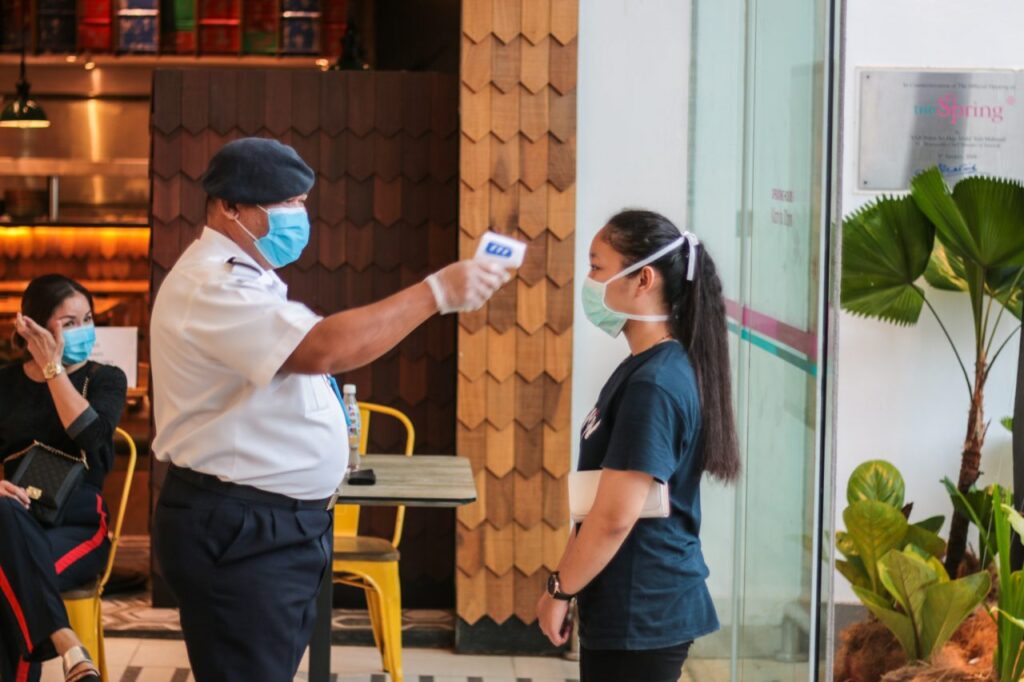
A security guard checks the temperature of a shopper at a mall. – File photo
KUCHING (May 20): Universiti Malaysia Sarawak’s (Unimas) Institute of Health & Community Medicine (IHCM) has detected seven cases of the Covid-19 South African Variant of Concern (VOC), B.1.351, here.
IHCM head, Prof Dr David Perera, said the earliest case they sequenced was tested positive for Covid-19 by RT-PCR on April 26 and the most recent case tested positive on May 6.
He said they had also detected additional cases of the P3 VUI variant in Samarahan and Sibu. The variant was first reported in the Philippines in March this year and was recently identified in import cases to the United Kingdom (UK).
“Additionally, we have detected a B.1.530 variant that appears to be dominant in Miri but also seen in Kuching. Finally, our data shows that the B.1.466.2 ‘Pasai’ variant continues to circulate throughout the state,” he said in a statement today.
Dr Perera said with these new findings of Severe Acute Respiratory Syndrome Coronavirus 2 (SARS-COV-2) variants of concern circulating in Sarawak, IHCM strongly emphasised the need for the public to continue adhering to the Standard Operating Procedures (SOPs) and guidelines, particularly mask-wearing, hand hygiene and physical distancing and the need to achieve herd-immunity through the vaccination programme.
He also urged the public to register for vaccination.
Dr Perera said the IHCM laboratory had completed genomic sequencing of over 600 samples and the genomic sequence data was shared in the Global Initiative on Sharing Avian Influenza Data (GISAID) global SARS-COV-2 sequence database.
“We recently reported that our variant surveillance study has identified the B.1.470 and B.1.524 lineages as the circulating variants in the third wave (Sept – Nov, 2020) and lineages B.1.470, B.1.524 and B.1.466.2 as the circulating variants in the fourth wave (December 2020 onwards) in Sarawak.
“Notably, the B.1.466.2 variant is related to the ‘Pasai’ cluster in Sarawak and this variant shares a mutation with the UK B.1.1.7 variant at position 681 of the SARS-COV-2 Spike protein that is associated with increased transmissibility.
“We had also reported the detection of a ‘Variant of Interest (VOI), the B.1.1.28.3 or P3 variant in the Kuching and Samarahan districts,” he said.
He said this P3 variant is characterised by a double mutation; the E484K mutation shared with the B.1.351 South African variant and the N501Y mutation shared with the B.1.1.7 UK variant.
These mutations, he added, had been associated with immune escape from both vaccine-induced and natural infection protection, and greater transmissibility.