


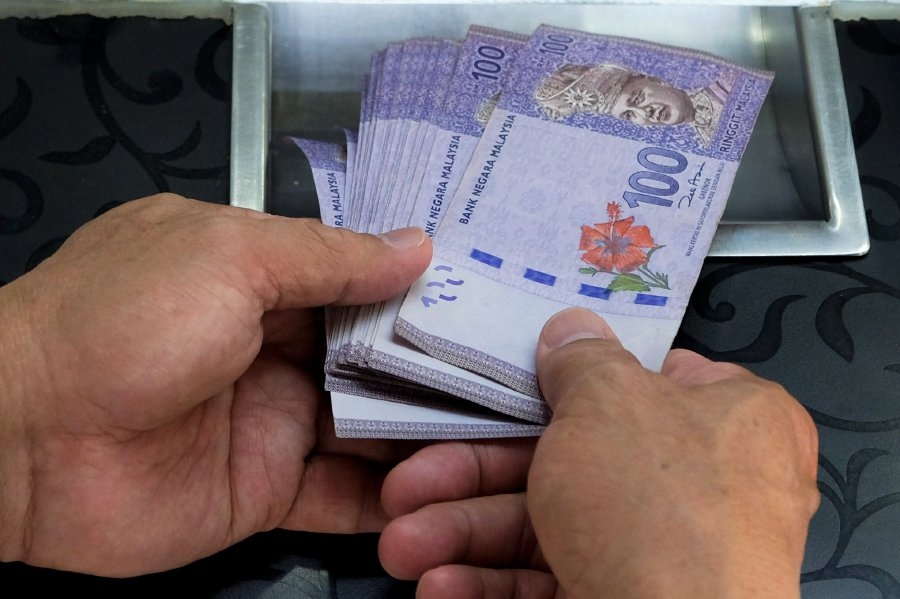
While the negative impact of the lockdown on asset quality was somewhat expected, MQ Research continues to believe that the risk remains skewed to the non-consumer book especially SMEs while consumer assets should rebound post lockdown. — Bernama photo
KUCHING: The June 2021 banking system data released by Bank Negara Malaysia showed pronounced impact from the third movement control order (MCO) mainly in consumption with both credit card spend and overall loan applications decelerating.
While the negative impact of the lockdown on asset quality was somewhat expected, Macquarie Equities Research (MQ Research) continued to believe that the risk remains skewed to the non-consumer book especially small and mid-size enterprises (SMEs) while consumer assets should rebound post lockdown.
“The third national lockdown (movement control order), MCO 3.0 which began on May 5, had a pronounced impact on the banking stats in June,” it said in its analysis yesterday.
“Credit card spend fell 19 per cent month on month (m-o-m) in June, to roughly 28 per cent below pre-Covid levels. This is still not as drastic as the 51 per cent drop seen in April 2020.
“Overall loan applications decelerated 12 per cent m-o-m in June, with consumer loan applications down 19 per cent m-o-m versus non-consumer relatively flat at 2.7 per cent m-o-m.”
MQ Research believed that lockdowns may have played a role in physically preventing consumers from facilitating loan applications. However, it was worth noting that applications for big-ticket items fell much more than discretionary borrowing.
“Residential property loan applications fell 18 per cent m-o-m, while automotive loan applications fell 50 per cent m-o-m,” it added. “Credit card and personal loan applications were flat m-o-m.
“Meanwhile, applications of working capital loans grew five per cent, during a lockdown, indicating businesses were still looking for liquidity.”
Loan repayments were an early indicator of asset quality stress. Overall, repayment levels dipped 1.9 per cent in June, with a disproportionate drop in consumer loan repayments of 12 per cent m-o-m.
Using historic repayment trends, MQ Research estimates the consumer loans-at-risk has increased from 10 to 11 per cent pre-lockdown to around 20 per cent in June.
Note, however, that consumer loan disbursements decelerated even more rapidly, by 27 per cent m-o-m.
While the automatic loan moratoriums had not yet been introduced (only beginning on July 7), MQ Research anticipated for banks to have already begun to extend targeted repayment assistance to distressed borrowers.
“With the repayment assistance structure in place, however, said loans-at-risk are unlikely to be impaired in the short term,” it added. “At the same time, it will also artificially lift consumer loans growth, which rose 5.2 per cent year on year (y-o-y) in June.”
Meanwhile, liquidity in the banking system remains ample, with loan-to-deposit ratios hovering at 88 per cent and current account savings account ratios at a record high 32 per cent, supportive of lower cost of funds in 2Q21 and better net interest margins.
Deposit growth (increase by 3.9 per cent y-o-y) has begun to converge on loans growth (increase by 3.4 per cent y-o-y). Liquidity coverage ratios rebounded to 149 per cent, against May’s 137 per cent).
MQ REsearch said the loan loss coverage ratio remained healthy at 112 per cent, while CET1 ratios of 14.2 per cent remained sufficient.
“The negative impact of the lockdowns on asset quality was somewhat expected, with a 10 per cent increase in potential repayment assistance in consumer loans.
“However, with resilient labour market conditions, we reiterate that risk remains skewed to the non-consumer book, particularly small and mid-size enterprises. Consumer assets should rebound post-lockdown.”